New television series hosted by Alan Kaufman featuring traditional musicians

Scene from "In the Tradition" with Alan Kaufman and Don Stratton

In addition to being a fine old time fiddler, guitarist, and singer, Alan Kaufman is incredibly knowledgeable about a variety of traditional American folk music genres of the 20th century. We were delighted to learn that Alan has launched a wonderful new television series called ” In the Tradition” produced by Arlington Community Media Inc television. The program, Alan explains, was inspired by the 50th anniversary of  Rainbow Quest, a television series Pete Seeger devoted to American folk music.

Two episodes of “In the Tradition” have aired to date and they are available to those outside of Arlington, MA through vimeo. Click here for the second episode in the series and stay tuned for more.

From Intern to State Folklorist and Published Author

It was a decade ago that CliffMurphy interned with the MCC’s Folk Arts & Heritage Program. A graduate student in ethnomusicology at Brown University at the time, Cliff was deep into his research on New England’s Country and Western music. I was fortunate to travel with him on a few of the many interviews he conducted with Massachusetts musicians — key figures like Georgia Mae Harp, “Jimmie Cal” Calderone, and yodelling Kenny Roberts.

Georgia Mae Harp with her signature white guitar Kenny Roberts album cover

His wonderful new book, Yankee Twang: Country and Western Music in New England was recently published by the University of Illinois Press. Not only is it an engaging and informative read, the book breaks new ground in country music scholarship by challenging the notion that country music is inherently southern.  New England Country and Western music is not the same thing as the country music heard across New England on country format radio. It is a homegrown, working-class regional music with deep roots. Read this book and you come to know a once vibrant regional music virtually ignored by the country music industry. Prior to the 1960s, talented performers dressed in country western garb, “barnstormed” their way across New England, doing live radio shows, performing community concerts, and playing for social dances.  New England’s multi-ethnic demographic makeup helped create a distinctive style of country music.

YankeeTwang book cover

We are fortunate to have had Cliff Murphy delve deep into one of New England’s core music traditions at a time when many of its exemplary performers were still alive. The documentary work Cliff did in Massachusetts is now safely archived in the MCC’s traditional Arts Archive. Cliff has since gone on to be the Director of Maryland Traditions, the folklife program of the Maryland State Arts Council. Massachusett’s loss is Maryland’s gain.

Listen to WBUR’s story about Cliff and Yankee Twang here

The Price and Promise of Leaving Home

Sushil_competing

Old Time musician Alan Kaufman and I were in Lowell to judge the 35th Annual Banjo & Fiddle Contest on September 6th. As the audience began to gather, Alan mentioned, “There is someone I want you to meet. A man from Nepal who plays the Himalayan fiddle (a four-stringed wooden instrument played with a bow), and jaw harp. His name is Sushil Gautam.” Alan explained that he had met Sushil at the local Dunkin’ Donuts in Arlington, where Sushil works. A few weeks earlier, Alan had walked in wearing a Banjo & Fiddle contest tee-shirt and the two got to talking. This is when Alan discovered that the man who serves him his ice tea is not only a Himalayan fiddle and jaw harp player, he also helped to establish The Music Museum of Nepal and published  a book on the history, ethnic songs, and methods of playing the Nepalese sarangi.

Sushil, Alan, and I spoke briefly before the contest began. Although Sushil had brought his sarangi, he was not planning on entering the contest. I told Sushil I’d be in touch soon about interviewing him for the MCC Folk Arts & Heritage Program. He kindly gave me a copy of his paperback, Sarangee, A Guide Book. The book, in Nepalese, was published by Orbit International Education Culture Education Department in Kathmandu, Nepal. Before walking away, Sushil handed me his business card, saying  “This is the view from my parent’s home.” It was a stunning panorama of the Himalayan Mountains with a small village in the foreground.

Sushil Gautam's business card

I stared at the picture, worthy of a travel brochure. Wrapped up in that little moment was the price of leaving home. The push/pull factors of limited economic opportunities, family, farm fresh food. . . .Why would someone leave such a place of physical beauty to resettle in a country halfway round the world. Clearly, it wasn’t the job. Or was it?

We scheduled a time for me to interview Sushil at his home in Somerville, where he lives with his wife and young daughter.

On September 12, I found my way to a rental house on a narrow side street off Somerville Avenue. I rang the doorbell.  At first, there was no response. I rang again. The windows were open; orange silk curtains fluttered in the screenless windows. I rang once more. Sushil appeared with a smile on his face and welcomed me into the front room of the house. It was sparsely furnished. Around the room were reminders of home —  photocopied color prints of family members and scenes from his parents’ village in Nepal. His daughter’s stuffed toys were piled in one corner. Several musical instruments were lined up against the back wall, resting on the carpeted floor; a few more hung from the walls. Sushil showed me two sarangis, one carved out of a lighter wood, and one of a darker, denser wood. The latter had an ornate carving of an elephant on the back. “Oh, Ganesha,” I remarked.  Sushil, surprised, asked “You know of Ganesha?”

Carving of Ganesha on back of sarangi

I asked if I could record our interview. He nodded and gestured to a small side table and two plastic chairs.

Economic opportunities and the chance to better his daughter’s future motivated Sushil and his wife to emigrate. Sushil Gautam came to this country with his wife and young daughter in January of 2013. “I grew up with tourism in my village.” Although the snow-capped Himalayas loom in the distance, snow never falls in his village. “All the year it is green.” Arriving in Boston, during the deep midwinter, came as somewhat of a shock. “I experience snow by my hand and leg here in Boston for the first time.”

Sushil had been selected by lottery for a green card and the opportunity to work and stay in the United States. Like many immigrants, he and his wife have university degrees, but can only find work in the food services. For now, Sushil is happy with his job at Dunkin’ Donuts, which provides an opportunity to improve his speaking skills in English. He has aspirations of finding a job as a teacher of languages and culture in the future.

Sushil Gautam playing a Nepalese sarangee

The sarangi is a bowed chordophone, carved from solid or composite wood, rather than pieced together like a violin. It has four strings; nylon has replaced gut (sheep intestine), and a metal string is used for the highest pitched string.  The sarangi is held vertically, much like a South Indian violin, or Chinese erhu. The outer two strings are tuned to an octave; the middle two strings are tuned a 4th up from the lowest string, e.g., G, C, C, G.  In western parlance, we’d call this an open tuning, meaning that all the strings are tuned to harmonized notes.   Some sarangi are highly ornamented, with carving depicting the God Ganesha or the Buddha.

Sushil Gautam posing with Nepalese sarangee

The Gandharba, a caste of occupational musicians, consider the sarangi to be their instrument. Until fairly recently, it was possible for them to make a living in Nepal. Much like other hereditary musicians, they played a key role in society, traveling from village to village, spreading news and entertaining.

Sushil recalls their music from his childhood, “Before there was any communication, people used to come to the mountain to entertain a lot of people. And they used to collect a lot of food for them. It was the living for this musician caste, and entertainment for the farmers in the mountain.  But time changes. A lot of radios and television came and the entertainment means are changed and these people lost their job.”

Sushil holding a jaw harp

Sushil playing the jaw harp

In generations past, the Gandharba caste were considered low and experienced discrimination. Although Sushil is from a historically higher caste, he plays the Gandharba’s instrument and has worked hard to elevate the musicians’ status and preserve their traditions. Sushil feels fortunate that he got to study with a very good teacher, Khim Bahadur Gandharba, who is a well-known sarangi player. In fact, he was the first sarangi player, selected by the king, to travel outside of Nepal to perform on a royal visit to Hong Kong and China.  Today, Khim Bahadur Gandharba is nearing 80, and is no longer physically able to play.

Sushil_3instruments

After earning his bachelor’s degree, Sushil moved to Nepal’s capital, Kathmandu, to pursue his masters in music. Before leaving Nepal, Sushil was teaching sarangi, performing, and making recordings. He also helped establish the Music Museum of Nepal, and wrote his guide to playing the sarangi. One of his motivations is to change the hereditary system of learning sarangi in Nepal, opening the instrument up to everyone.

“When the father wanted the child to chance to learn, even in the same ethnic group, if the caste, if somebody’s father does not know how to play sarangi, even though they belong to the same caste, they have no chance to learn. Because they don’t have a teacher. And they don’t have a book. With the generation gap, now, from my book, everybody can learn sarangi. Even if their father is not a sarangi player.”


Six New Apprenticeships Funded by MCC

We are delighted to announce this year’s Traditional Arts Apprenticeship grants. The following six traditional art forms will be taught by master artists to their apprentices: Irish uilleann pipe playing, South Indian carnatic singing, sign painting and gold leaf, ornamental and architectural wood carving, North Indian Madhubani painting, and South Indian carnatic drumming.

Irish uilleann pipe playing: Joey Abarta, master artist and Caroline O’Shea, apprentice

JoeyAbarta_full____________________________________________________________________

South Indian carnatic singing: Tara Anand Bangalore, master artist and Pratik Bharadwaj, apprentice

Bangalore_Bharadwaj_main

_________________________________________________________________________

Sign painting and gold leaf: Josh Luke of Best Dressed Signs, master artist and Corinna D’Schoto, apprentice

JoshLuke_main___________________________________________________________________________

Ornamental and architectural wood carving: Dimitrios Klitsas, master artist and Spiro Klitsas, apprentice

KlitsasApprenticeship_main___________________________________________________________________________

North Indian Madhubani painting: Sunanda Sahay, master artist and Sanjana Krishna, apprentice

Sahay_apprenticeship_main___________________________________________________________________________

South Indian carnatic drumming on mridangam: Gaurishankar Chandrashankar, master artist and Kaasinath Balagurunath, apprentice

Chandrashankar_apprenticeship_main

Apprenticeships are a long-standing method by which an individual learns skills, techniques, and artistry under the guidance of a recognized master. Applicants were reviewed by a panel of experts who evaluated the artistry of the master artist, skill level of the apprentice, rarity of art form, significance of the tradition,  appropriateness of the pairing, and work plan. Grantees are expected to offer a community presentation at the end of their 9-month long apprenticeship.

To see a list of all MCC-funded apprenticeships since 2002, click here.

MCC announces Artist Fellowships in the Traditional Arts

MCC is delighted to announce the 2014 Artist Fellowships in the Traditional Arts. Two artists will receive  fellowships in the amount of $10,000 and four artists will receive $500 finalist awards. For more information on MCC Artist Fellowships, look here.

ARTIST FELLOWS:

Elizabeth James Perry, Wampanoag weaving and wampum

Hand woven sash by Elizabeth James Perry

Elizabeth James Perry, (Wampanoag Tribe of Gay Head) is a fiber artist whose work reflects time-honored Wampanoag materials, techniques, and aesthetics. A scholar of Northeastern wampum and indigenous fiber arts, her work focuses on early contact-period Northeastern Woodlands Algonquian material culture, which features woven regalia (twining, weft weaving), natural dyes, and wampum adornment. She has been the recipient of a New England for the Arts grant (NEFA) and served as a master artist in the Southern New England Traditional Arts Apprenticeship Program.

Selected exhibitions include the Peabody Essex Museum, Salem, MA; Mashantucket Pequot Museum & Research Center, Mashantucket, CT; National Seashores Salt Pond Visitor Center, Eastham, MA; The Boston Children’s Museum, Boston, MA; Aquinnah Cultural Center, Martha’s Vineyard, MA; and Roger Williams University, Bristol RI.

Jimmy Noonan, Irish flute and tin whistle playing

Jimmy Noonan at Boston College Jan 23 2014. Photo: Paul Wells

Jimmy Noonan is an Irish flute and tin whistle player who grew up steeped in the traditional music of County Clare, Ireland. He learned from traditional musicians who, as he says, were “the pillars of their society, playing for weddings, funerals and political events; their importance was immense.” Dedicated to passing on the tradition, Noonan has run his own music schools in Cleveland and Boston. National Heritage Fellow Seamus Connolly invited Noonan to teach at Boston College, where he has been an adjunct professor in the music department since 1996. In addition, he has taught at many of the premier Irish Music Summer Schools in the country including Gaelic Roots, Catskills Irish Arts Week, and Milwaukee Irish Fest.  Selected recordings include The Maple Leaf: Irish Traditional Music from Boston and The Clare Connection.

FINALISTS:

Thomas Matsuda, Japanese Buddhist woodcarving

Thomas Matsuda at Lowell Folk Festival 2014. Photo: Greg Cook

Japanese monks inspired Thomas Matsuda to study his art in Japan. He apprenticed under one of the leading classical Buddhist sculptors in Japan, Koukei Eri. Masuda went on to develop his own distinct style, while living in a remote Japanese mountain village, where he carved more than two hundred sculptures for temples, shrines, and patrons. A decade later, Matsuda returned to the Massachusetts, where he continues to carve Buddhist sculpture and to teach. Influenced by the rough-hewn rustic style of Enku, Matsuda’s works, rendered in stone and wood, can be found displayed among leading Buddhist centers and temples.  Selected commissions include a 7-ton marble Buddha for the Grafton Peace Pagoda in Grafton, NY and Budda’s Feet for the Leverett Peace Pagoda in Leverett, MA.  He has demonstrated woodcarving at several Lowell Folk Festivals.

Daphne Board, Custom shoemaking

Hand made shoes by Daphne Board

Cordwainer Daphne Board makes made-to-measure, custom built shoes and boots using wooden or plastic lasts.  She learned her cordwaining skills through an apprenticeship with a shoemaker in Nova Scotia, who himself had learned from an Italian shoemaker. Since then, she has set up own shop in Holyoke. Board is a member of the Honorable Cordwainers Company. She relies on a small community of shoe and bootmakers for advice, locating leather suppliers, and continuing to learn traditional techniques.  In addition to her stunning leather work and keen eye for color, Daphne Board is on her way to becoming a certified pedorthist, someone skilled in making orthotics and treating foot problems. “I’m interested in not only making beautiful shoes, but shoes for people who cannot wear factory made, stand-sized shoes.” Board served as a master artist in 2013 Southern New England Traditional Arts Program and was a craft artist at 2012 Lowell Folk Festival, Lowell, MA.

Vincent Crotty, European sign craft

Cumann na nGaeilge sign by Vincent Crotty

For the past 23 years, Vincent Crotty has been making hand-painted signs created using old-world techniques like wood-graining, marbleizing, freehand lettering, and pictorial designs. Traditional sign craft, a skill that has almost been obliterated by computer graphics, is an art form that has been handed down from father to son, master to apprentice, for centuries. Born in Ireland, Crotty learned his craft in his 20s, at a trade school called Fas, where his teachers had learned through the old-world guild system. Tools of the trade include sign quills and special sable hair brushes; materials include sign enamels, gold leaf, varnish, and shellac.

Crotty’s work can be found on neighborhood storefront signage throughout Boston, local churches, pubs, and on signage for Irish music festivals around the country. Selected commissions include The Irish Cultural Centre, Canton, MA; Irish Arts Week, East Durham, NY; Codman Academy, Dorchester, MA; St. Mark’s, St. Ambrose, St. Margaret’s, St. Peter’s, and St. Ann’s, Dorchester, MA; St. Ann’s, Quincy, MA.

Mal Barsamian, Armenian and Middle Eastern music

Malcolm Barsamian on saxophone

Multi-instrumentalist Malcolm Barsamian grew up in a household rich in Middle Eastern music. He comes from a family of oud players starting from his grandfather, his father, his great-uncle, and uncle. His father, Leo, had four-year-old Malcolm sitting in on dumbeg at Armenian picnics. As a youngster, Barsamian listened to old recordings of Armenian and Middle Eastern Masters, picking up the ability to improvise. Classical training enhanced his musical skills and his ability to perform Armenian and Middle Eastern music.

He has gone on to become a sought-after player of the oud and dumbeg, as well as instruments such as clarinet, guitar, and saxophone, performing in the Armenian and Greek communities for over thirty years. Barsamian is well schooled in the underlying theory of Turkish classical music, and related music of the Middle East, Armenia, and the Balkan countries. In addition to teaching, Barsamian plays regular for concerts, community events, weddings, and festivals concerts, reinvigorating and preserving the music of his Armenian heritage. Selected performances include the Armenian Festival, Watertown, MA; Armenian Festival, 2008; Birmingham, MI; Lowell Folk Festival, 2012, Lowell, MA; The St. Athanasius Greek Orthodox Church, Arlington, MA;Tufts University, 2010, Medford, MA; and The African Museum,2013, Detroit, MI. Barsamian recorded One Take: Armenian Dance Songs in 2005.


“The Beautiful Music All Around Us”

Stephen Wade holding a copy of his book

Last week I had the good fortune of introducing Stephen Wade at the Cambridge Forum in Harvard Square. Like an archaeologist revisiting a dig site 75 years later, Wade went back to 13 Southern towns where folklorists working for the Library of Congress had recorded locally known singers and musicians.  These field recordings went on to become iconic of Southern old time banjo and fiddle music, blues, children’s lore, cowboy songs, and other forms of American folk music.

William Stepp on horseback

In addition to doing some serious library research, Wade was able to track down living relatives or acquaintances, finding himself in places where everyday people made music:  living rooms, front porches, church pews, prisons, and dance halls. During his November 13 presentation in Cambridge, he told stories from his travels in researching and writing The Beautiful Music All Around Us: Field Recordings and the American Experience. He also performed on a number of banjos, including one originally belonging to musician Hobart Smith. Take a look and listen —


Watch Live webcast of National Heritage Fellows Concert

We are coming up on the last week of September, which means it’s time for the annual feting of our country’s National Heritage Fellows. This year’s fellows include former Massachusett’s resident and Irish fiddler extraordinaire, Seamus Connolly.

The National Council for Traditional Arts and the National Endowment for the Arts produce a spectacular evening performance September 27th at Lisner Auditorium on the George Washington University campus. Fortunately, for those unable to attend the concert, the event will be live streamed at arts.gov,  with an archive available following the event. Viewers can share comments and photos on
Twitter using the hashtag #NEAHeritage. You may also request copies of
the concert program by emailing heritage@arts.gov.

Seamus Connolly named National Heritage Fellow

We are delighted to share the exciting news that Irish-born and longtime Massachusetts resident  Séamus Connolly has been named a National Heritage Fellow by the National Endowment for the Arts. Though he recently moved to Yarmouth, Maine, we still like to claim him as one of our own.

In drafting his nomination letter, Irish music journalist Earle Hitchner writes, “I can think of no Irish traditional musician more qualified and deserving than Séamus Connolly for a National Heritage Fellowship from the National Endowment for the Arts. His achievements as an Irish traditional fidder, music school organizer, and music teacher are long and lustrous. . . First and foremost is his fiddling, a combination of virtuosity and vitality that stamps his style of playing as original, unique, and highly influential . . . Every time he picks up the fiddle — whether on stage, in a recording studio, in a class, or in an informal session —  Séamus both preserves and advances the Irish tradition. His zeal and love for this music are as ardent now as they were when he was a boy in Ireland, and the body of art and work he has created is exceptional and formidable.”

Séamus Connolly grew up in a home filled with music in Kilaloe, County Clare, Ireland. He won his first All-Ireland National Fiddle Championship only ten months after initially picking up the fiddle and it wasn’t long before he gained national prominence. He joined the famous Kilfenora Ceili Band, traveling throughout Ireland and Britain playing for dances, concerts, and radio broadcasts and television programs.

Séamus came to the United States in 1972 as a member of the first Comhaltas Ceoltóirí Eireann (CCE) tour, an ensemble of 26 musicians, singers and dancers. He then returned in 1976 and settled in the Boston area. At the request of the Boston branch of CCE, Séamus agreed to teach and pass on to American-born students the various regional styles of Irish fiddling.

Séamus directed the highly acclaimed Gaelic Roots Summer School and Festival at Boston College from 1993 – 2003. In 2004, Boston College named Connolly the “Sullivan Artist in Residence.” He also coordinates a Gaelic Roots Series of free concerts and lectures by visiting artists throughout the academic year. In 1990 and 2004, he was awarded a Fellowship in Traditional Arts by the Massachusetts Cultural Council;  he was also awarded three Master/Apprenticeship Grants for teaching traditional Irish music.

Séamus often performed and recorded with two stellar musicians —  Irish button accordion player   Joe Derrane, who won a National Heritage Fellowship in 2004, and guitarist John McGann, a gifted guitarist and mandolin player, who passed away unexpectedly in 2012.

Indeed, it has been a momentous year for  Séamus — On May 11, 2013, he was awarded another highly prestigious prize: the Ellis Island Medal of  Honor, given by the National Ethnic Coalition of Organizations to American citizens for their outstanding contributions to the United States. An exhibition titled ” the Musical Roots of Seamus Connolly” recently ran at Boston College’s Burns Library.

We are so very proud of you  Séamus.


All in the Family: Learning from Master Musicians

It’s that time of year when the MCC’s Traditional Arts Apprenticeships are wrapping up for the year. As part of the grant program, recipients are required to share what they have learned in a public presentation. This coming Sunday, May 19th, two master/apprentice teams will perform musical selections and share some of the joys and challenges of transmitting musical heritage. The free presentation takes place at Lowell National Historical Park Visitor Center theater, 246 Market Street and will begin at 2:30 p.m.

Two continents. Two ancient percussive traditions. And two young people with the good fortune to be born into musical familes headed by master musicians. Balla Kouyaté is a virtuoso player of the balafon, the ancient West African ancester of the xylophone and marimba. Above, you see him teaching his son Sekou the balafon.

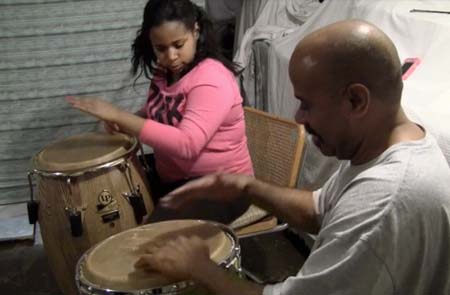
Sixto “Tito” Ayala comes from a legendary music and dance institution in Puerto Rico – the Ayala family. He is pictured here teaching a conga rhythm to his daughter Estefany Navarro.

Come see and hear how West African djeli music and Puerto Rican bomba & plena are being passed on from one generation to the next.


Model Making: Ship Models & Pipe Organs

On Sunday afternoon, April 21st, the Lowell Folklife Series will present an intriguing program featuring three master craftsmen.  Joining us will be National Heritage Fellow and shipwright  Harold A. Burnham, noted maritime historian and ship modeler Erik Ronnberg, Jr., and Greg Bover of CB Fisk, Inc.  With hand-crafted models up on stage, they will talk about the role of model-making in the building of world class pipe organs, 60-foot wooden schooners, and historic miniatures of seafaring vessels.

For Burnham, a half-hull ship model is a design tool. Bover’s company, CB Fisk, Inc., creates scale models to ensure that each pipe organ complements the architecture that surrounds it. For Ronnberg, the full-hull ship model is a historical representation, a form of visual storytelling. All three individuals are well-known to each other, and hold each other’s skills and knowledge in high regard. Their discussion will no doubt be full of fascinating details, tricks of the trade, and little-known facts about the importance of model-making.

This event is free and open to the public. It will take place in Lowell National Historical Park’s Visitor Center theater on Sunday April 21, 2013 at 3:30 p.m. For more information, visit www.nps.gov/lowe or call 978-275-1719.

css.php