Blessing ceremony for kiln building

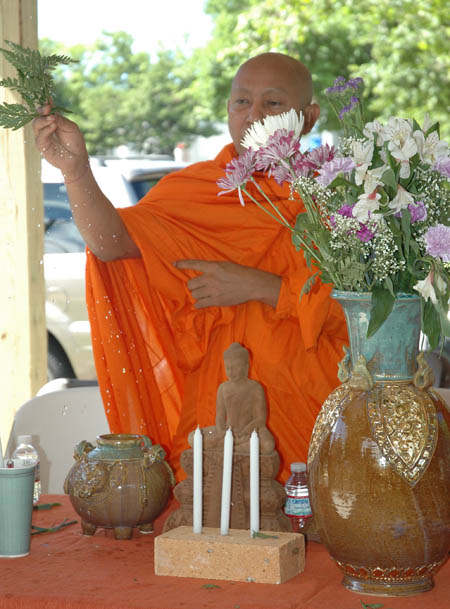
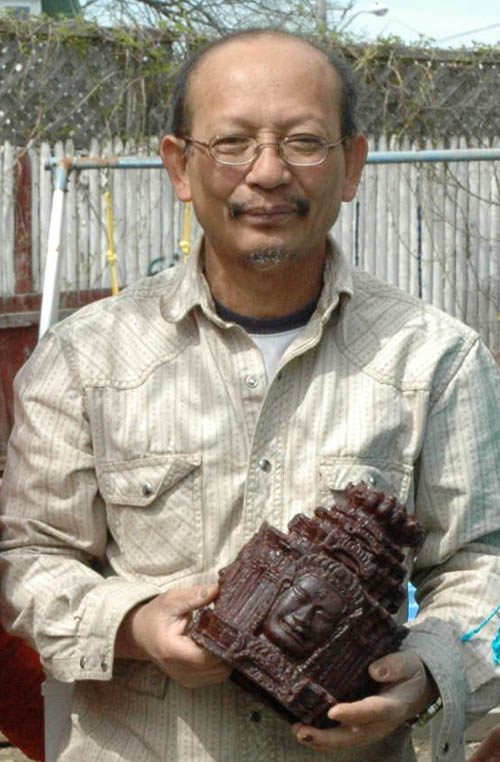
A blessing ceremony for the new Cambodian wood fire kiln took place in Lowell on June 28. In order to ensure a successful project, the potters Yary Livan and Proeung Kang made offerings and prayed to the designer of Angkor Wat, King Suryavarman II, whom Yary calls “the hero of construction.” Proeung just arrived from Cambodia where he teaches at the Secondary School of Fine Arts. He and Yary both grew up in the same village along the Mekong Delta and have known each other since childhood. 

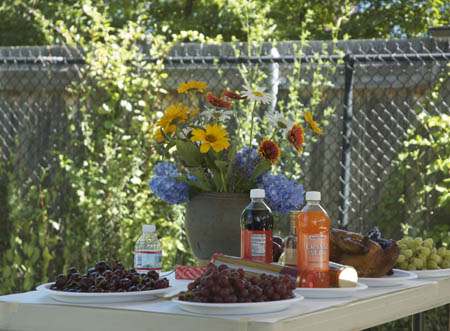
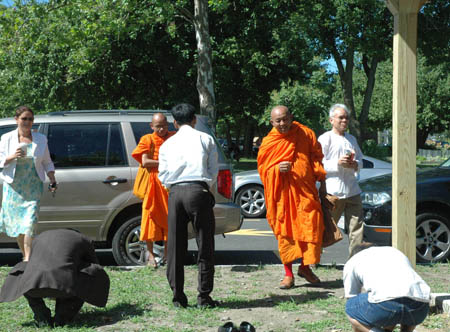
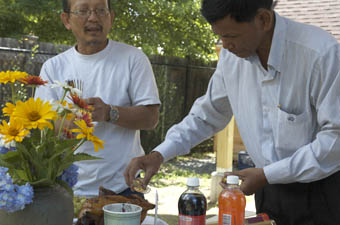
Two Buddhist monks in bright orange robes from the Wat Khmer Temple in Lowell came for the occasion. On the altar, Yary prepared offering of grapes, apples, cherries, and a whole roasted chicken (complete with dipping sauces!), next to a vase of freshly picked flowers. 


Marge Rack, professor of art at Middlesex Community College  (MCC), gave a welcoming address, translated by Tooch Van, International Student Advisor at MCC, to the approximately fifteen people attending. She said that this project was “a dream come true,” and it was her vision to build a ceramics community that not only included Lowell but Cambodia as well.

Celeste Bernardo, the new Superintendent of Lowell National Historical Park, said that “heritage is made strong by the many cultures in our community,” and that the Lowell community helps spread and continue traditions of the Cambodian people.


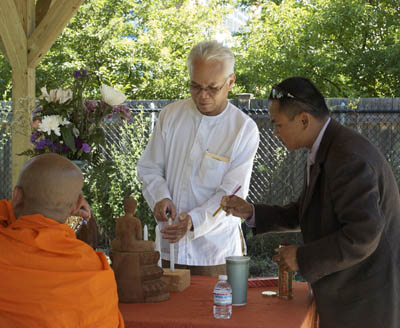
A clergyman, or achar, lit three tall white candles placed on an orange brick, and gave an introduction in both Sanskrit and Pali, the liturgical language of Buddhism. The two monks chanted the Dhamma in Sanskrit while dipping flowers into pottery bowls of water and sprinkling water over the kiln’s foundation.


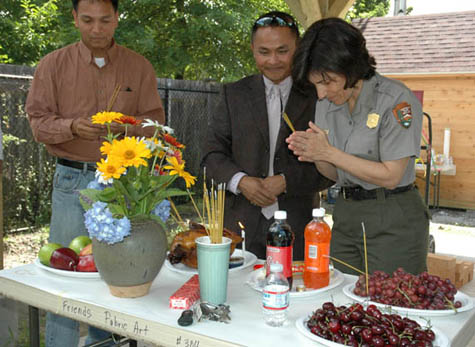
At the altar, Yary lit a candle,while Proeung poured pinot grigio over the chicken. Holding a bundle of incense sticks, Yary prayed and chanted over the offerings, then placed one burning incense stick each into an apple, a grape, a cherry, and the chicken.


Cambodian customs are a mix of animism, Hinduism, Buddhism. The altar incorporated the symbolically important Hindu number of seven. Yary said traditionally the altar holds seven different kinds of food and seven kinds of fruit, what he called “seven times seven.”


The art department of MCC had generously presented Yary and Proeung with a hand truck so they wouldn’t hurt their backs! They will be helped by Samnang Khoeun, an architect and Yary’s former apprentice, and Vanny Hang, a sculptor from Lawrence who is a specialist in Khmer ornamentation. The artisans collaborate together in their studio in the Western Studios building in Lowell.  To follow progress on the kiln project, click here.

Photos by Maggie Holtzberg. Group shot by Samnang Khoeun.

Lithuanian Summer Solstice

I’m delighted to be working with state folklorist Maggie Holtzberg in Lowell this summer.  On the summer solstice, Maggie and I went to visit Jonas Stundzia at his home in Lawrence to learn about Rasos Svente, the Dew Festival, and the ways Lithuanians celebrate the longest day of the year. He will be demonstrating how to make floral head garlands at this year’s Lowell Folk Festival. Garlands, or wreaths, are an important part of this solstice festival, also known as the festival of Saint John.

Jonas is a wealth of folklore. When we got to his house, he welcomed us with a traditional Lithuanian greeting. From a decorative ceramic pitcher, he poured water over our hands, and held out a woven Lithuanian cloth to dry them. He then offered us cucumbers dipped in honey and small cups of samagonas (rye moonshine). He said that cucumbers dipped in honey are eaten as a summer treat only in the northeast area of Lithuania.

Jonas showed us his garden blooming with plants native to Lithuania, including wild sorrel, used in making soup; ruta (rue), the national flower; wild onions; and lavender. His garden also had winter rye, used for Christmas decorations; parsley; mint; wild straw; and wild dahlia. He showed us a large oak garland he had made. Oak is considered a male tree and oak garlands are usually reserved for men. We tried it on anyway, and it was heavy! In Lithuania, garlands made of wild flowers, healing herbs, and grasses are used in the solstice festival to adorn the head, decorate the homestead, float candles on the water, and burn in the bonfire.

Jonas had made another large circular garland with linden and yellow flowers which symbolize the sun. Lithuanians consider linden a female plant; this wreath could be worn by a woman, or decorated with lit candles to be floated on the water on the evening of the Rasos Svente festival. The points of light guide the sun back home to earth. Wreaths symbolize the circle of life. Circles and wheels are important in Lithuanian mythology. In one pre-Bronze age myth the sun travels across the sky pulled by a goat. Jonas told us that Lithuanian rituals and language go back to proto Indo-European times. They still survive today because Lithuania was geographically isolated far up north on swampy land that nobody else wanted. Lithuanian is an ancient language, but still living, unlike Sanskrit or Latin.

On the summer solstice, Lithuanians give kupole staffs to friends and neighbors to protect and bless their homes. Jonas showed us a kupole staff he had made with healing herbs: nettle (good for healing arthritis and a relaxation); wormwood (good for the nerves); southern wort (a nerve relaxant used to make absinthe liquor); mountain ash (considered a male plant, used in the celebration of St. John); and belladonna (a medicinal nightshade).

Next, he showed us decorative iron saule, which means “sun.” One had a circle, which represents the sun; branches which represent the tree of life; jagged thunderbolts; curved snakes; and roots representing the earth. In Lithuania, snakes are symbols of life. Gyvate means snake; gyvas means life. The first animals to appear from Mother Earth in the spring are the toad and the snake. Thunderbolts allude to the god of thunder who creates rain, and therefore gives life.

Other saule he showed us had Christian crosses. He said that Roman Catholics had adopted and reinterpreted the form of the saule and used them in cemeteries to decorate gravestones.  In the same way, the pre-Christian kupole staff transformed into a similar, but smaller and more compact staff used on Palm Sunday. The rituals of the Rasos Svente festival also were adopted into Saint John’s Day celebrations. We look forward to hearing more of his stories at his demonstration tent at the folk festival in July.

All photos by Maggie Holtzberg.

Massachusetts shipwright wins national honor

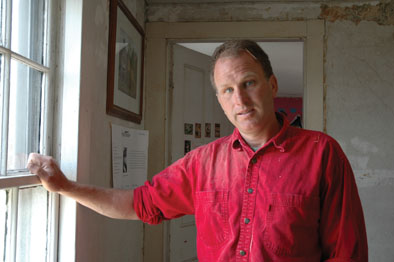
  Harold Burnham standing at home: 2006:

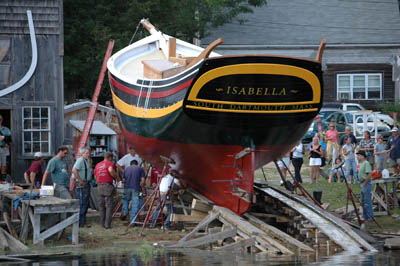
We first nominated Harold A. Burnham for a National Heritage Award back in 2001.  This year’s fellows have just been announced and we are delighted to see Harold among those receiving the nation’s highest honor in the folk and traditional arts.  Having built a number of timber-framed schooners, Burnham holds true to traditional materials and techniques. Using hand tools familiar to a nineteenth-century shipwright, he works out-of-doors through New England winters, and launches vessels the old way using wedges, grease, and gravity. 

  Launch of Isabella; Apprenticeship - wooden boat building; 2006: Essex, Massachusetts

Burnham has essentially revived a once dormant shipbuilding technique and in doing so has reconnected the town of Essex to its own shipbuilding heritage. He credits place as much as family legacy for enabling him to do what he does, “. . . it’s hard to imagine a place on earth where shipbuilding is more deeply embroidered into the fabric of the community.”

For more info on this year’s National Heritage Fellows, click here.


Yary builds a wood-burning kiln


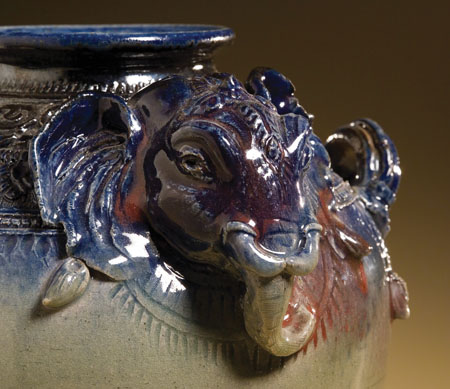
We last wrote about Cambodian ceramicist Yary Livan when he received an Artist Fellowship from the Massachusetts Cultural Council this past Spring. Livan’s work draws on the rich heritage of Cambodian culture, including influences from ancient imperial Khmer kiln sites, such as Angkor Wat, and incorporates Khmer imagery, relief carving, and design. 

The big news in his life is that after having no decent place to work or fire his ware, Yary not only has studio space at Western Avenue Studios , he is in the process of building a wood-burning kiln on land owned by the National Park Service. Middlesex Community College, who is sponsoring the project, has created a blog : “On this blog one can follow events at Yary’s Kiln, 220 Aiken St. Lowell, MA, with photos and interviews; find out when the kiln will be fired; learn how to sign up for workshops, to visit, view exhibits or find sales of traditional Cambodian woodfire pottery.”

We’ll be stopping by from time to time as well, to see how things are progressing at the kiln site. Come September, the Lowell Folklife Series will host a firing of the newly finished kiln.

Next Lowell Folklife Series features RUMBAFRICA

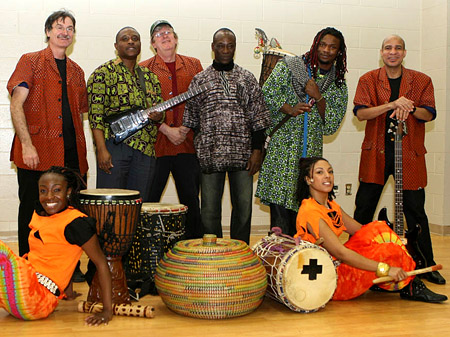
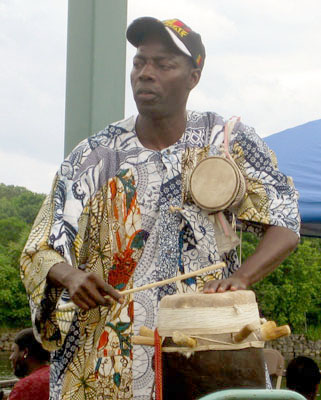
The Lowell Folklife Series  is pleased to support the headliner band, Rumbafrica at the 2012 African Festival in Lowell, MA. The festival takes place Saturday June 16, 2012 at the Sampas Pavillion along Pawtucket Boulevard. Rumbafrica is led by Congolese guitarist/singer Tshibangu Kadima. They play a rumba dance music called Soukous (derived from the French word meaning “to shake”), which originated in the 1930s. The group features a variety of African percussion and several dancers.  They will  be performing sets at 2:00 pm, 4:00 pm, and 6:00 pm.

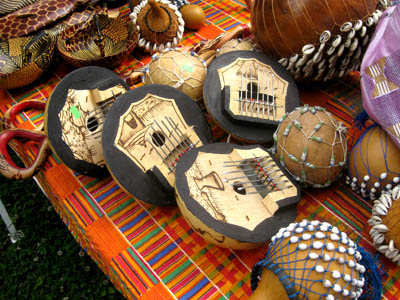
In addition to live music and dance performances throughout the day, there will be traditional African crafts and food. Below are some photos from our visit to the festival in 2009

African Festival, Ethnic festival, 2009; African Festival of Lowell; Lowell, Massachusetts; Photography by Signe Porteshawver

Drummer in Mamadou Diop band; Ethnic festival; 2009:

Young boys in African Festival t-shirts; Ethnic festival; 2009: Lowell, Massachusetts

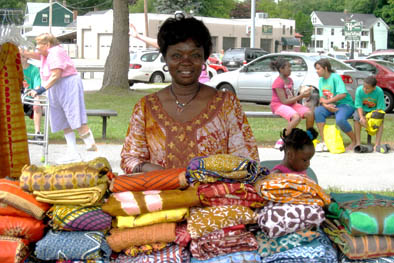
Woman selling African fabrics; Ethnic festival; 2009: Lowell, Masachusetts

Festival photos taken by Signe Porteshawver for the Folk Arts & Heritage Program at Massachusetts Cultural Council.

In search of a hat maker: notes from the field

Back in March, I had attended “Crowning Glories: Hat Show and Contest” in Roxbury. I was hoping to see some fancy hats, the kind traditionally worn to church by African American women. The event was hosted by the Friends of Dudley Street  Branch Library and it was the first hat show they had organized. It appeared to be modeled on traditional African American hat shows and contests. Nearly all of the 30 or so women who attended came wearing a hat. Some were crocheted, others were adorned with brooches or feathers, but all in all, they were rather modest. As for seeing more elaborate hats, several folks suggested observing what women wear on Easter Sunday. “Try New Hope Baptist Church in Boston’s South End.”  Folklorist friend Kate Kruckemeyer, who grew up in the South End, also suggested United Methodist on Columbus Avenue. “It’s the home church for many. There are so many cars that the police let people double-park in the middle of Columbus Avenue.”

The website of Union United Methodist indicated that Easter Sunday services would let out at 12:30.  So I made my way there, arriving at 12:30 p.m. on Easter Sunday. Everyone appeared to still be inside. 


There was a temporary wooden crucifix draped with a long narrow white cloth, whipping around on this windy day. The faint sound of organ music indicated that the service had not ended. A young girl entered the building so I decided to follow her inside. People were shaking each other’s hands, giving hugs, carrying Easter lilies, and generally making their way out of the sanctuary. I looked around to see a mostly black congregation, but there were some white folks too. Amidst the crowd, I spotted only one woman wearing a fancy hat. I slowly wound through the crowd and left to stand on the sidewalk outside.

About ten minutes later, the doors opened and parishioners began to trickle out. First to leave was a woman and a young boy, talking about how much they had enjoyed the service.

A few others emerged, and then the woman with the large white hat exited. I admired her outfit and asked her if I could take her picture. She smiled and agreed. Though she’d bought her hat in Baltimore, she did recall there being several hat shops in Roxbury, near Dudley station.

The lack of headwear at Union United Methodist was a bit of a disappointment. I thought I’d try to find New Hope Baptist Chruch, even though I didn’t know their Easter Sunday schedule. Got a little lost driving around the South End. Finally, as I circled around back toward Tremont, I saw a woman on her way to a large granite stone chuch, which turned out to be New Hope Baptist.


Several women were exiting the church and they were wearing large, fanciful hats.  So I risked double-parking on a side street and made my way to the door. A man was about to enter and he motioned for me to go first. In the foyer were an older seated couple and an older woman on her way out. Both women were wearing hats, so I began a conversation with them, letting them know I was looking to find anyone who might make hats locally. The gentleman knew of someone names Sykes. He offered to bring me inside to try to find her. More women came out of the sanctuary wearing hats and I asked them where they got them. One answered, “Oh honey, I got this online.”  As she was leaving she offered the name of several websites that sold hats. The older gentleman spoke up, with a touch of impatience in his voice saying, “No, she’s looking for a local maker.”

I was delighted to see he had taken interest in my quest. We walked into the hallway that separates the sanctuary from the function hall. The service, led by Rev. Willie Dubose, Jr., was still ongoing – I think I came in during the offertory prayer/doxology.  The band consisted of a guitar, bass, keyboard and drums and they were rocking. 

The service ended and people slowly began to make their way out. White was the predominant dress and hat color. No one seemed to mind my presence. Many seemed eager to pose for photographs. 


I left after most others had gone outside. It was chilly for April and people didn’t linger.  Several older women were boarding a van. Others walked. I took a few more photos.

Just as I was starting to leave, I noticed a lovely outfit on a woman who was about to get into her car. After commenting on her outfit, I asked to take her photograph.

I was fully expecting  her to tell me she had bought her hat online, but asked anyway, “Do you happen to know who made your hat?” “Yes,” she answered. “I did.” Turns out, she is Ms. Sykes, the woman who several people had mentioned. I told her I’d been looking to find a local hat maker and asked for her email. 

A few days later I sent her an email telling her about my interest in African American hats, my wish to learn more, and the “Head to Toe” theme of this summer’s folk craft area of the Lowell Folk  Festival.  I attached the photo I’d taken of her, which showed off her lovely pink hat and matching blouse.

Dear Ethel: It was a pleasure meeting you (ever so briefly) on Easter Sunday.  I had admired your hat and asked you about it. Attached is the photo I took.  I’d come by New Hope Baptist Church at the suggestion of several women who had organized the hat show at the Dudley Street Branch Library on March 17th. I’ve been wanting to learn more about the African American tradition of wearing fancy hats to church — and was delighted to see so many beautiful hats this past Easter Sunday at New Hope Baptist Church. Many of the women I spoke to told me they had bought their hats online or in a shop. So I am thrilled to meet you and hear you say you had made your hat yourself!

I curate the Folk Craft area of the Lowell Folk Festival ( www.LowellFolkFestival.org). This year our theme is “Head to Toe” and I am in the process of identifying traditional artists who craft a variety of head gear (hats, Caribbean carnival headdresses, crowns, head wraps, etc.) and foot wear (handmade shoes of all kinds).

I’d like to be able to learn more about your hatmaking and perhaps see if you might consider participating as a craft demonstrator at the festival. If you think you might be interested, let me know how and when I can reach you be telephone.

Regards,

Maggie


Ethel wrote back right away.

Dear Maggie:

You are very good at what you do. I will be looking forward to talking with you.

Thanks again,

Ethel


In all my years of doing folklore field research, I’ve never had anyone tell me that.

I phoned Ethel at work on 4/12/12.  She’d be happy to meet with me in her home studio, as long as I can come by on a weekend. Ethel makes hats for herself, as well as for others, and still has a few hats on hand which she made for a hat show for the Shriners. She mentioned that she would be traveling to Tennessee for a school reunion, after that would be fine. 

 To be continued . . .


Learning to carve letters in stone

We first came to know Jesse Marsolais as an apprentice to letterpress printer John Kristensen. An old soul, Jesse has embraced the black art of printmaking and brings new life to the craft. So we were not surprised to learn that Jesse has the rare opportunity to apprentice under third generation stone carver, calligrapher, and designer   Nick Benson  at the John Stevens Shop in Newport, Rhode Island. Lucky for us, Jesse is  blogging about his experience, “Six Weeks in the John Stevens Shop.” We suggest you give it a read.

Jesse’s six-week apprenticeship is funded by the Southern New England Folk & Traditional Arts Apprenticeship Program.  This unique tri-state apprenticeship program allows apprentices to work with master artists across state lines in Massachusetts, Connecticut, and Rhode Island. The next deadline is October 4, 2012.

Gateway Cities: When Neighborhoods Change

Many of Massachusetts’ de-industrialized mill and manufacturing towns are known as “gateway cities.”  Home to close-knit communities of immigrants who initially came seeking work in the state’s once thriving mill and manufacturing sectors, gateway cities have been hit hard by job loss and poverty. Average household incomes remain below the state average as do educational attainment rates.

Gateway cities are often the starting place for new immigrants, who are drawn by the affordable housing and competitive business opportunities. In cities like Lawrence, Lowell, Springfield, and Brockton, and Fall River, it is not uncommon for aging Irish, French-Canadian, Greek, and Polish populations to live alongside a new generation of newcomers, emigrating from places like Nigeria, the Dominican Republic, Puerto Rico, Cambodia, and Vietnam.

When it comes to the practice of faith, this globalization means that once mono-cultural parishes are now multi-cultural, with multi-lingual masses. The 2009 documentary film Scenes from a Parishis a window into this world.

The   Lowell Folklife Series invites you to a screening of this powerful  film, with special guest  James Rutenbeck, the film’s director. Shot over four years in Lawrence, Massachusetts, the film sensitively captures the ethnic working class tensions of a multi-cultural Catholic parish in a hard-pressed former mill town.

Come see this award-winning documentary and join the discussion about how communities adjust as neighborhoods change. Free and open to the public.

Date: April 11, 2012 at 7:30

Place: Visitor Center Theater, Lowell National Historical Park, 246 Market Street, Lowell, MA


The Hat Ladies of Fiesta

It’s late March and we are well into planning the folk craft area of the 2012 Lowell Folk Festival. Though the festival is best known for its music and food, there has long been a vibrant showing of traditional craft by artists who demonstrate their work under tents located along the canal in Lucy Larcom Park.  The theme for the area this year is “Head to Toe” and we are in the process of identifying people who craft a variety of head gear (hats, Caribbean carnival headdresses, crowns, head wraps, etc.) and foot wear (handmade shoes of all kinds).

High on my list for awhile has been finding the Hat Ladies of Fiesta. The first I’d heard of them was in the summer of 2009, when I was lucky to have two college interns who spent the summer documenting ethnic festivals around Massachusetts. (Ellen Arnstein and Signe Porteshawver’s fieldwork is sprinkled throughout our Keepers of Tradition website).  A highlight for them was attending Gloucesters’ St. Peter’s Fiesta in late June, which honors the patron saint of fishermen. In amongst their photos were shots of two women wearing fantastic hats.

After a little research I discovered their identity: Robyn and Amy Clayton.  As it turns out, the Clayton sisters are known around Gloucester as “The Crazy Hat Ladies of Fiesta.” Their outlandish hats have become an integral part of St. Peter’s Fiesta.  I wrote them a letter back in December and soon after had an invitation to come meet with them in Gloucester to learn all about their hats.

What started as a backyard party 18 years ago has grown into a highly anticipated display of creativity.  It’s just around this time of year that Robyn and Amy begin working on their Fiesta hats. Made from scratch, each hat replicates in miniature key elements of Fiesta:  local churches, temporary altars, the St. Peter statue, the greasy pole competition, Gloucester’s fishing fleet, concession stands, and carnival rides.

A couple of weeks ago, I found myself sitting at the kitchen table in Robyn Clayton’s home. Spread out on nearly every available surface were hats from previous years and supplies for creating this year’s hats including large light slabs of foam core, pipe cleaners, glue, popsicle sticks, paint, Sculpey clay, Legos, and  HO-scale model railroad figures.

Robyn modeled last year’s hat for me. “My friends joke that when I put this hat on, I’m going to need some kind of out riggers because they think it’s so heavy, but it really isn’t heavy. It’s just a little awkward if it’s really windy out.” Not to be missed is Robyn’s replica of herself on her hat, wearing her signature hat, standing in front of the working Ferris wheel.

Though they create new hats with a new theme each year, some things stay the same.  Amy’s hats always include the greasy pole and Robyn’s always feature the altar. All the references are local. Robyn points out a perennial figure, “This guy here is always on my hat. He’s Ambie, the sausage man. He’s also my UPS man. It looks just like him.  Made him out of some Legos, some Sculpey clay, and the left over umbrella from a Mai-Ti.”

Robyn describes the early days of Fiesta, “Way back when, when there was a huge fishing fleet, this was a huge celebration. The carnival wasn’t involved.  This was about people dressing their houses. They would put their old quilts out the window.  Fiesta has been going on for a long time. Same thing for the greasy pole competition. What they did was, they just paraded St. Peter up and down. It was about the feast.  It was about praying for people’s families and the safety of their men. . . St. Peter has been put around different areas. He used to sit in the old grocery store windows. As the fishermen would go out to their boats, as they went by St. Peter, they would pray to him. Just keep us safe. Bring us back home.”

The original life-size statue of St. Peter, which was brought over from Italy in 1927, remains the centerpiece of what has become a five-day celebration. Recently, Robyn was inspired to make her own statue of St. Peter. During the year, the statue of St. Peter is kept at the Saint Peter’s Club on Rogers Street; Robyn’s Saint Peter hibernates in her cellar.


I wonder aloud what the older, Italian generation of Fiesta think of this relatively new addition to their festival. “The old Italian women absolutely love these hats,” Robyn says. “The Fiesta committee [which is made up of mostly men], they recognize us as the crazy fiesta hat girls. Here we come. By no means are we mocking the Fiesta; we love this tradition.”

The Clayton sisters are elated to be coming to the Lowell Folk Festival this July, where  they will join a variety of other hat and shoe makers in the folk craft area. They plan on bringing plenty of hats, some handouts,  pictures of Fiesta over the years, and a huge cut-out of St. Peter for photo-taking opportunities. Their enthusiasm for hat making will be matched by their pride in representing Gloucester and St. Peter’s Fiesta. We’re honored to have them.


Sophia Bilides sings Smyrneika


Sophia Bilides. Photo by Valerie Catrow, 2009.

We have been trying to get this superb singer to the Lowell Folk Festival for many years, but she has always been away in Greece during the festival. Not only will Sophia Bilides be appearing at this summer’s folk festival, she and her trio will be performing for the Lowell Folklife Series, in an 8:00 p.m.   concert this Saturday, March 24th.

Sophia Bilides is considered the “foremost practitioner of the Greek singing style known as Smyrneika” (Boston Globe), the cabaret song tradition of the Greek Asia Minor refugees of the 1930s and ‘40s. She accompanies herself on santouri (the Greek hammered dulcimer) and zilia (finger cymbals), backed by master musicians Mal Barsamian on outi (oud) and kythara (guitar), and Mike Gregian on doumbeleki (hand drum). Although many in Lowell’s Greek community won’t need it, Bilides  provides translations and song contexts to help bring audiences into the intimate atmosphere of an Anatolian cafe-aman. Song lyrics, which are set to richly intricate melodies, Middle Eastern modes, and sensual rhythms, voice the universal themes of nostalgia for lost homelands, endurance, love in all its guises, and the celebration of life.

Consider joining us as we celebrate Women’s History Month and Greek Independence Day by attending this free concert on March 24th in the Visitor Center of Lowell National Historical Park. No reservations required.

css.php