Cambodian Kiln Fires Up!

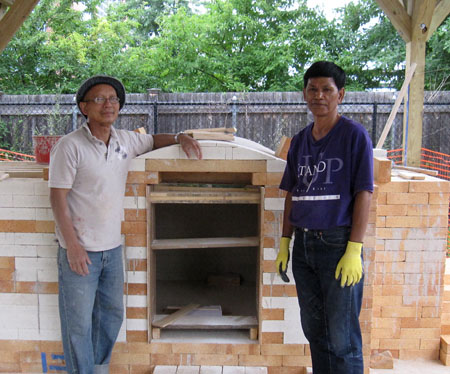
A few months ago, we told you about a blessing ceremony  held for the building of a Cambodian wood fire kiln in Lowell, Massachusetts. We are excited to announce that the kiln is completed and will be fired up for the very first time on Saturday September 22, 2012.

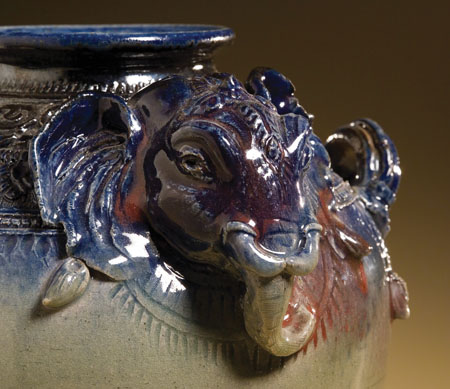
As one of only three master ceramicists to survive the Khmer Rouge genocide, Yary Livan is one of only two still actively creating pottery. The other is Kang Proeung, visiting artist from Cambodia. He and Yary grew up in the same village along thet Mekong Delta and have known each other since childhood.


Together they have built a Cambodian-style wood fire kiln in Lowell, on the grounds of the National Park Service maintenance facility. Their hope is that this kiln, and the ware that is fired inside of it, will help insure that Cambodian ceramics can continue and flourish. It is a tradition that dates back to the Angkor Kingdom, which was at its height during the 11th century.


Livan, Proeung, and others will be on hand to explain the kiln’s design, the firing process, and features of the Khmer ceramic pieces that will be burning inside. For more information, click here.

 36 hours left before the kiln is lit . . .   Stopped by this afternoon to see Proeung busy glazing ware and Yary inside the kiln making measurements.

Lowell Folk Festival Highlights

We had great fun at this year’s Lowell Folk Festival, where artisans demonstrated the folk art of head and foot gear. Who knew there were so many ways to adorn the head and protect the feet?


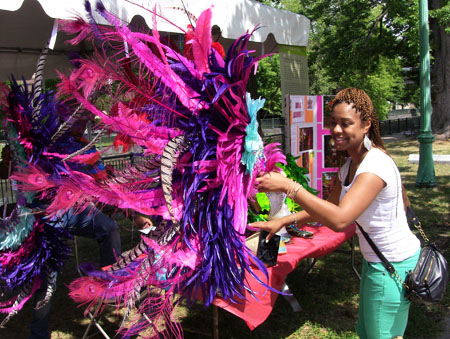
Luidgi Felix and Nicole Scott from the Trinidad and Tobago Social Club brought several Caribbean Carnival headdresses to show. These handmade costumes are worn by dancers in Boston’s annual Caribbean Carnival.

Here Nicole Scott shows off one of their creations. Months of work go into constructing these costumes made of wire, steel, feathers, sequins, and glitter.

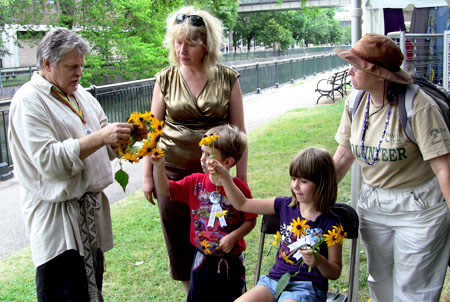
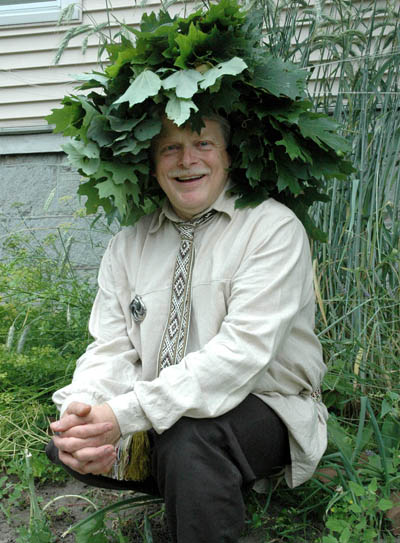
Jonas Stundzia brought the tradition of Lithuanian Midsummer celebration to Lowell. Under a huge double-horsehead gate, to the sound of Lithuanian folk songs, he created head garlands out of oak leaves and wild flowers. Visitors joined in, making garlands for themselves. 

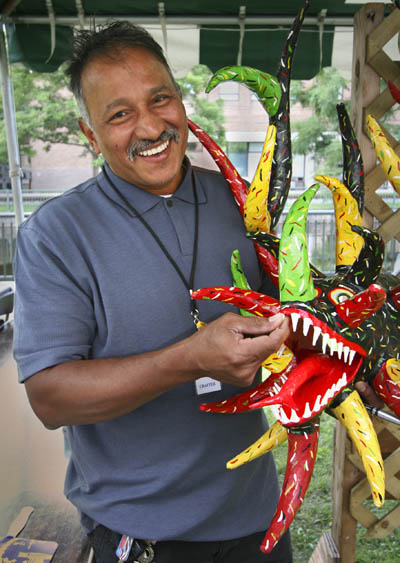
Angel Sánchez Ortiz  brought his Puerto Rican vejigante masks used for carnival celebrations.  His striking, fantastical masks of boldly painted papier mâché depict animals, legendary people, and sometimes spirits and monsters that are imbued with cultural meaning.

Qamaria Amatul-Wudud designs and sews fashionable clothing for Islamic women who choose to dress modestly. She brought some of her elegant dresses and showed visitors how to wrap headscarves.


Eniko Farkas brought her Hungarian beaded maiden crowns worn by unmarried girls after confirmation. Before marriage, they would ritually replace them with a married woman’s headdress. Eniko also talked with visitors about the traditional Hungarian art of embroidery.

Our own J. Arthur Poitras from Lowell seemed to have brought his entire cobbler’s shop with him. There were pliers, knives, creams, and even a hanging shoe last.


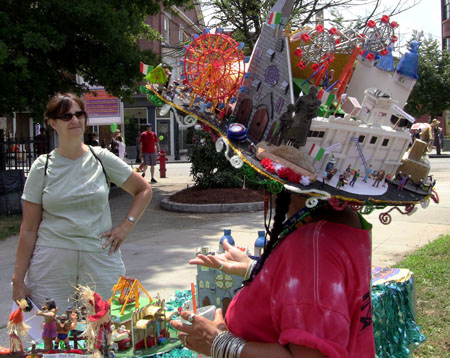
The infamous “Hat Ladies” of Gloucester, Amy and Robyn Clayton amazed people with their whimsical hats. Here, Amy hands out pamphlets about the Saint Peter’s Fiesta next to their handmade statue of Saint Peter. 

The “Hat Ladies” make a new hat every year for the Saint Peter’s Fiesta, featuring local sights in miniature. For the Lowell Folk Festival, they even brought a life-size cut out of Saint Peter for visitors to pose with.

Theodore Green entranced visitors as he constructed hand built shoes out of leather. If you looked down, you may have noticed his own glittering gold shoes!

Samuel Brown and his custom made hats were a big hit. It was all he could do to keep the ladies from walking off with his hats on their heads.

Faith Izevbijie demonstrated how to tie gele, Nigerian headwraps.


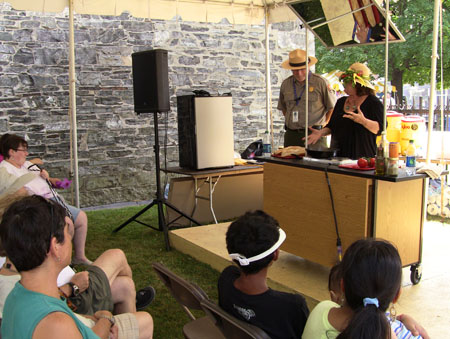
And, last but not least, there were tomatoes, lots of tomatoes. Eleni Zohdi was one of five cooks demonstrating recipes using tomatoes. Here she explains how to make a Greek dish called Kayiana, with Lowell NHP Chief of Cultural Resoruces David Blackburn looking on.

We all had a good time and hope you did too. If you missed it, there’s always next year!

Photos and blog by Lesley Ham


From Head to Toe: Adorn & Protect

 
These are just some of the craft artists and traditions you will find at this year’s Lowell Folk Festival in the Folk Craft area of Lucy Larcom Park. They craft a variety of gear to progect and adorn the head and the feet.  Using an array of materials, techniques, and styles, each craftsperson works within well-established traditions. Some  creations express religious devotion or ethnic identity, others sheer practicality. Many fulfill a cultre-based license to be “on display.”


 For more info on the 2012 Lowell Folk Festival click here.  Hope to see you on July 28 & 29th!


Blessing ceremony for kiln building

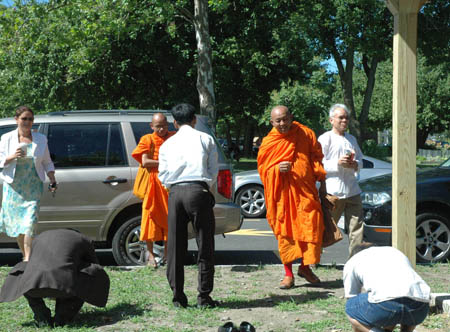
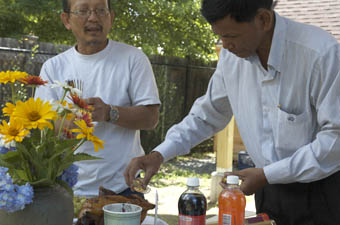
A blessing ceremony for the new Cambodian wood fire kiln took place in Lowell on June 28. In order to ensure a successful project, the potters Yary Livan and Proeung Kang made offerings and prayed to the designer of Angkor Wat, King Suryavarman II, whom Yary calls “the hero of construction.” Proeung just arrived from Cambodia where he teaches at the Secondary School of Fine Arts. He and Yary both grew up in the same village along the Mekong Delta and have known each other since childhood. 

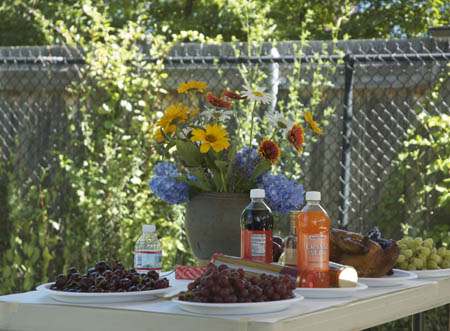
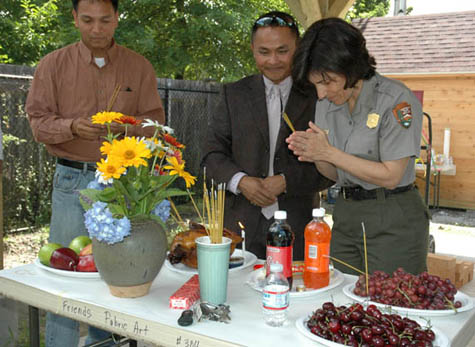
Two Buddhist monks in bright orange robes from the Wat Khmer Temple in Lowell came for the occasion. On the altar, Yary prepared offering of grapes, apples, cherries, and a whole roasted chicken (complete with dipping sauces!), next to a vase of freshly picked flowers. 


Marge Rack, professor of art at Middlesex Community College  (MCC), gave a welcoming address, translated by Tooch Van, International Student Advisor at MCC, to the approximately fifteen people attending. She said that this project was “a dream come true,” and it was her vision to build a ceramics community that not only included Lowell but Cambodia as well.

Celeste Bernardo, the new Superintendent of Lowell National Historical Park, said that “heritage is made strong by the many cultures in our community,” and that the Lowell community helps spread and continue traditions of the Cambodian people.


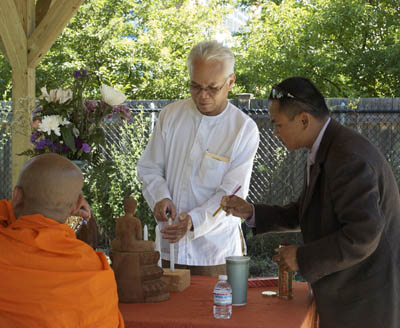
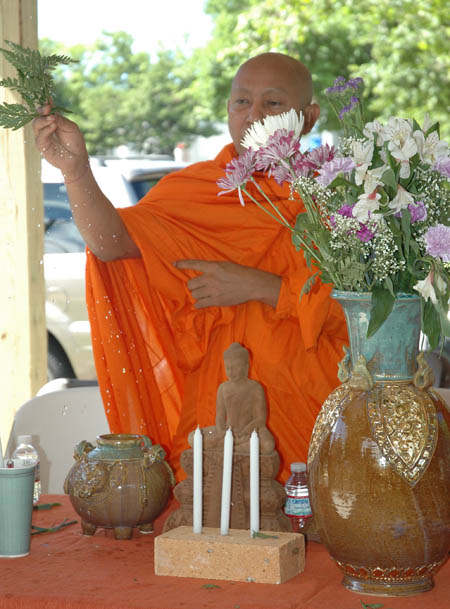
A clergyman, or achar, lit three tall white candles placed on an orange brick, and gave an introduction in both Sanskrit and Pali, the liturgical language of Buddhism. The two monks chanted the Dhamma in Sanskrit while dipping flowers into pottery bowls of water and sprinkling water over the kiln’s foundation.


At the altar, Yary lit a candle,while Proeung poured pinot grigio over the chicken. Holding a bundle of incense sticks, Yary prayed and chanted over the offerings, then placed one burning incense stick each into an apple, a grape, a cherry, and the chicken.


Cambodian customs are a mix of animism, Hinduism, Buddhism. The altar incorporated the symbolically important Hindu number of seven. Yary said traditionally the altar holds seven different kinds of food and seven kinds of fruit, what he called “seven times seven.”


The art department of MCC had generously presented Yary and Proeung with a hand truck so they wouldn’t hurt their backs! They will be helped by Samnang Khoeun, an architect and Yary’s former apprentice, and Vanny Hang, a sculptor from Lawrence who is a specialist in Khmer ornamentation. The artisans collaborate together in their studio in the Western Studios building in Lowell.  To follow progress on the kiln project, click here.

Photos by Maggie Holtzberg. Group shot by Samnang Khoeun.

Lithuanian Summer Solstice

I’m delighted to be working with state folklorist Maggie Holtzberg in Lowell this summer.  On the summer solstice, Maggie and I went to visit Jonas Stundzia at his home in Lawrence to learn about Rasos Svente, the Dew Festival, and the ways Lithuanians celebrate the longest day of the year. He will be demonstrating how to make floral head garlands at this year’s Lowell Folk Festival. Garlands, or wreaths, are an important part of this solstice festival, also known as the festival of Saint John.

Jonas is a wealth of folklore. When we got to his house, he welcomed us with a traditional Lithuanian greeting. From a decorative ceramic pitcher, he poured water over our hands, and held out a woven Lithuanian cloth to dry them. He then offered us cucumbers dipped in honey and small cups of samagonas (rye moonshine). He said that cucumbers dipped in honey are eaten as a summer treat only in the northeast area of Lithuania.

Jonas showed us his garden blooming with plants native to Lithuania, including wild sorrel, used in making soup; ruta (rue), the national flower; wild onions; and lavender. His garden also had winter rye, used for Christmas decorations; parsley; mint; wild straw; and wild dahlia. He showed us a large oak garland he had made. Oak is considered a male tree and oak garlands are usually reserved for men. We tried it on anyway, and it was heavy! In Lithuania, garlands made of wild flowers, healing herbs, and grasses are used in the solstice festival to adorn the head, decorate the homestead, float candles on the water, and burn in the bonfire.

Jonas had made another large circular garland with linden and yellow flowers which symbolize the sun. Lithuanians consider linden a female plant; this wreath could be worn by a woman, or decorated with lit candles to be floated on the water on the evening of the Rasos Svente festival. The points of light guide the sun back home to earth. Wreaths symbolize the circle of life. Circles and wheels are important in Lithuanian mythology. In one pre-Bronze age myth the sun travels across the sky pulled by a goat. Jonas told us that Lithuanian rituals and language go back to proto Indo-European times. They still survive today because Lithuania was geographically isolated far up north on swampy land that nobody else wanted. Lithuanian is an ancient language, but still living, unlike Sanskrit or Latin.

On the summer solstice, Lithuanians give kupole staffs to friends and neighbors to protect and bless their homes. Jonas showed us a kupole staff he had made with healing herbs: nettle (good for healing arthritis and a relaxation); wormwood (good for the nerves); southern wort (a nerve relaxant used to make absinthe liquor); mountain ash (considered a male plant, used in the celebration of St. John); and belladonna (a medicinal nightshade).

Next, he showed us decorative iron saule, which means “sun.” One had a circle, which represents the sun; branches which represent the tree of life; jagged thunderbolts; curved snakes; and roots representing the earth. In Lithuania, snakes are symbols of life. Gyvate means snake; gyvas means life. The first animals to appear from Mother Earth in the spring are the toad and the snake. Thunderbolts allude to the god of thunder who creates rain, and therefore gives life.

Other saule he showed us had Christian crosses. He said that Roman Catholics had adopted and reinterpreted the form of the saule and used them in cemeteries to decorate gravestones.  In the same way, the pre-Christian kupole staff transformed into a similar, but smaller and more compact staff used on Palm Sunday. The rituals of the Rasos Svente festival also were adopted into Saint John’s Day celebrations. We look forward to hearing more of his stories at his demonstration tent at the folk festival in July.

All photos by Maggie Holtzberg.

Massachusetts shipwright wins national honor

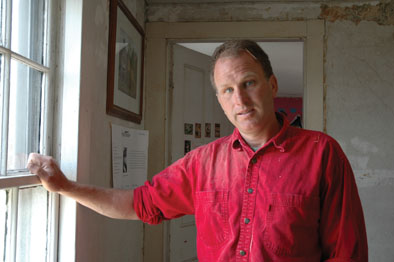
  Harold Burnham standing at home: 2006:

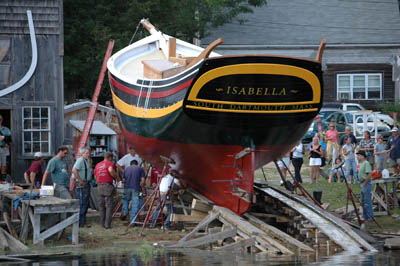
We first nominated Harold A. Burnham for a National Heritage Award back in 2001.  This year’s fellows have just been announced and we are delighted to see Harold among those receiving the nation’s highest honor in the folk and traditional arts.  Having built a number of timber-framed schooners, Burnham holds true to traditional materials and techniques. Using hand tools familiar to a nineteenth-century shipwright, he works out-of-doors through New England winters, and launches vessels the old way using wedges, grease, and gravity. 

  Launch of Isabella; Apprenticeship - wooden boat building; 2006: Essex, Massachusetts

Burnham has essentially revived a once dormant shipbuilding technique and in doing so has reconnected the town of Essex to its own shipbuilding heritage. He credits place as much as family legacy for enabling him to do what he does, “. . . it’s hard to imagine a place on earth where shipbuilding is more deeply embroidered into the fabric of the community.”

For more info on this year’s National Heritage Fellows, click here.


Yary builds a wood-burning kiln


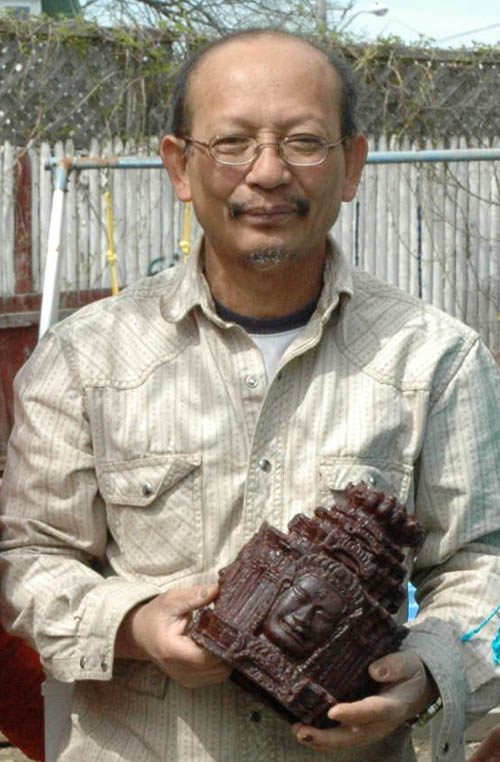
We last wrote about Cambodian ceramicist Yary Livan when he received an Artist Fellowship from the Massachusetts Cultural Council this past Spring. Livan’s work draws on the rich heritage of Cambodian culture, including influences from ancient imperial Khmer kiln sites, such as Angkor Wat, and incorporates Khmer imagery, relief carving, and design. 

The big news in his life is that after having no decent place to work or fire his ware, Yary not only has studio space at Western Avenue Studios , he is in the process of building a wood-burning kiln on land owned by the National Park Service. Middlesex Community College, who is sponsoring the project, has created a blog : “On this blog one can follow events at Yary’s Kiln, 220 Aiken St. Lowell, MA, with photos and interviews; find out when the kiln will be fired; learn how to sign up for workshops, to visit, view exhibits or find sales of traditional Cambodian woodfire pottery.”

We’ll be stopping by from time to time as well, to see how things are progressing at the kiln site. Come September, the Lowell Folklife Series will host a firing of the newly finished kiln.

Learning to carve letters in stone

We first came to know Jesse Marsolais as an apprentice to letterpress printer John Kristensen. An old soul, Jesse has embraced the black art of printmaking and brings new life to the craft. So we were not surprised to learn that Jesse has the rare opportunity to apprentice under third generation stone carver, calligrapher, and designer   Nick Benson  at the John Stevens Shop in Newport, Rhode Island. Lucky for us, Jesse is  blogging about his experience, “Six Weeks in the John Stevens Shop.” We suggest you give it a read.

Jesse’s six-week apprenticeship is funded by the Southern New England Folk & Traditional Arts Apprenticeship Program.  This unique tri-state apprenticeship program allows apprentices to work with master artists across state lines in Massachusetts, Connecticut, and Rhode Island. The next deadline is October 4, 2012.

The Hat Ladies of Fiesta

It’s late March and we are well into planning the folk craft area of the 2012 Lowell Folk Festival. Though the festival is best known for its music and food, there has long been a vibrant showing of traditional craft by artists who demonstrate their work under tents located along the canal in Lucy Larcom Park.  The theme for the area this year is “Head to Toe” and we are in the process of identifying people who craft a variety of head gear (hats, Caribbean carnival headdresses, crowns, head wraps, etc.) and foot wear (handmade shoes of all kinds).

High on my list for awhile has been finding the Hat Ladies of Fiesta. The first I’d heard of them was in the summer of 2009, when I was lucky to have two college interns who spent the summer documenting ethnic festivals around Massachusetts. (Ellen Arnstein and Signe Porteshawver’s fieldwork is sprinkled throughout our Keepers of Tradition website).  A highlight for them was attending Gloucesters’ St. Peter’s Fiesta in late June, which honors the patron saint of fishermen. In amongst their photos were shots of two women wearing fantastic hats.

After a little research I discovered their identity: Robyn and Amy Clayton.  As it turns out, the Clayton sisters are known around Gloucester as “The Crazy Hat Ladies of Fiesta.” Their outlandish hats have become an integral part of St. Peter’s Fiesta.  I wrote them a letter back in December and soon after had an invitation to come meet with them in Gloucester to learn all about their hats.

What started as a backyard party 18 years ago has grown into a highly anticipated display of creativity.  It’s just around this time of year that Robyn and Amy begin working on their Fiesta hats. Made from scratch, each hat replicates in miniature key elements of Fiesta:  local churches, temporary altars, the St. Peter statue, the greasy pole competition, Gloucester’s fishing fleet, concession stands, and carnival rides.

A couple of weeks ago, I found myself sitting at the kitchen table in Robyn Clayton’s home. Spread out on nearly every available surface were hats from previous years and supplies for creating this year’s hats including large light slabs of foam core, pipe cleaners, glue, popsicle sticks, paint, Sculpey clay, Legos, and  HO-scale model railroad figures.

Robyn modeled last year’s hat for me. “My friends joke that when I put this hat on, I’m going to need some kind of out riggers because they think it’s so heavy, but it really isn’t heavy. It’s just a little awkward if it’s really windy out.” Not to be missed is Robyn’s replica of herself on her hat, wearing her signature hat, standing in front of the working Ferris wheel.

Though they create new hats with a new theme each year, some things stay the same.  Amy’s hats always include the greasy pole and Robyn’s always feature the altar. All the references are local. Robyn points out a perennial figure, “This guy here is always on my hat. He’s Ambie, the sausage man. He’s also my UPS man. It looks just like him.  Made him out of some Legos, some Sculpey clay, and the left over umbrella from a Mai-Ti.”

Robyn describes the early days of Fiesta, “Way back when, when there was a huge fishing fleet, this was a huge celebration. The carnival wasn’t involved.  This was about people dressing their houses. They would put their old quilts out the window.  Fiesta has been going on for a long time. Same thing for the greasy pole competition. What they did was, they just paraded St. Peter up and down. It was about the feast.  It was about praying for people’s families and the safety of their men. . . St. Peter has been put around different areas. He used to sit in the old grocery store windows. As the fishermen would go out to their boats, as they went by St. Peter, they would pray to him. Just keep us safe. Bring us back home.”

The original life-size statue of St. Peter, which was brought over from Italy in 1927, remains the centerpiece of what has become a five-day celebration. Recently, Robyn was inspired to make her own statue of St. Peter. During the year, the statue of St. Peter is kept at the Saint Peter’s Club on Rogers Street; Robyn’s Saint Peter hibernates in her cellar.


I wonder aloud what the older, Italian generation of Fiesta think of this relatively new addition to their festival. “The old Italian women absolutely love these hats,” Robyn says. “The Fiesta committee [which is made up of mostly men], they recognize us as the crazy fiesta hat girls. Here we come. By no means are we mocking the Fiesta; we love this tradition.”

The Clayton sisters are elated to be coming to the Lowell Folk Festival this July, where  they will join a variety of other hat and shoe makers in the folk craft area. They plan on bringing plenty of hats, some handouts,  pictures of Fiesta over the years, and a huge cut-out of St. Peter for photo-taking opportunities. Their enthusiasm for hat making will be matched by their pride in representing Gloucester and St. Peter’s Fiesta. We’re honored to have them.


Traditional Arts Fellows and Finalists, a Diverse Group

Every other year, the Massachusetts Cultural Council awards  Artist Fellowships in the traditional arts, recognizing individuals for their artistic excellence, authenticity, and deep roots in traditional culture. Among the awardees this year is Irish-American button-accordion player Joe Derrane (Randolph, MA), who is also a National Heritage Fellow.
JOE DERRANE, Irish American accordion player

Joe Derrane is a living legend in the Irish traditional music community. Born in  Boston to Irish immigrant parents, Derrane developed an early affinity for the button accordion and Irish traditional music. At age 14, he was playing regularly in the ballroom dance scene that was booming in the Dudley Street section of Roxbury. At age 17, Derrane recorded the first in a series of 78-rpm recordings, which have since become legendary in the Irish music world. Decades later, Derrane’s musicianship is marked by his unique ornamentation, vigor, and flawless execution.  In addition to his virtuosity on the button box, Derrane is known for his tune compositions, many of which have entered the repertoire of Irish musicians on both sides of the Atlantic.

____________________________________________________________

YARY LIVAN, Cambodian ceramicist

An MCC Artist Fellowship also went to  Yary Livan (Lowell, MA), master of traditional Cambodian ceramics and kiln building. His work draws on the rich heritage of Cambodian culture, including influences from ancient imperial Khmer kiln sites, such as Angkor Wat, and incorporates Khmer imagery, relief carving, and design. Livan recently served as master artist in MCC’s Traditional Arts Apprenticeship Program, passing on what he knows of kbach, the basic element of design in Khmer art, to apprentice Samnang Khoeun. The two are building a smokeless wood-burning kiln on the grounds of Lowell National Historical Park.

__________________________________________________________

In addition to these two Artist Fellowships in the Traditional Arts, four Finalist awards were announced.

VERÓNICA ROBLES, Mariachi musician

Verónica Robles has Mariachi music in her blood. “I first learned the traditoinal music of my home country, Mexicao, from my grandmother, whom I would spend hours with in the kitchen as she prepared dishes such as chicharron prensado, con calabazas, elote y nopales.  .  . ” It was in Mexico City’s Plaza Garibaldi, the cradle of Mariachi music, where Verónica was introduced to the Mariachi group led by El Chiquis. She began working with his group at age 15, learning hundreds of songs and musical styles. Robles has made Massachusetts home since 2000, where she specializes in performing for young audiences through school assembles, residencies and dance workshops. Her television show, Orale con Verónica, has been on the air since 2002.

________________________________________________________

KHENPO CHOPEL, Tibetan torma maker

Khenpo Chopel was born in Tibet and became a monk at the age of 14. Holding the title of “khenpo” (a spiritual degree given after three years of intensive study in Tibetan Buddhism), Chopel is a master torma  maker and tantric practitioner.  Tormas (pictured above) are a traditional art form essential for everyday practice in Tibetan Buddhist monasteries and households. These ritual forms — in conical shapes of bright colors — are made both as an offering to a deity and as a representation of a deity.  Since 2009, Chopel has been living at the Drikung Meditation Center in Arlington, Massachusetts, where he serves as a master torma-maker and tantric practitioner.

________________________________________________________

JORGE ARCE, Afro Caribbean percussionist and educator

Jorge Arce grew up in the Bélgica, a working class neighborhood of Ponce, Puerto Rico. Ponce is known as the wellspring of bomba, plena, and danza, traditional Afro Caribbean styles of music and dance. Born into a family of dancers and singers, Arce grew up with Plena folk groups and musicians.  Arce credits Don Rafael Cepda and family with expanding his knowledge of bomba. In addition to his life-long work in Bomba and Plena, Arce is an experienced actor, dancer, and cultural historian. He is considered an expert on the history of Puerto Rican’s African people and their descendants. Touring the United States since 1975 as a musician and educator, Arce continues to give workshops, lectures, residencies and performances at schools, festivals, and community organizations.

________________________________________________________

DANNY MEKONNEN, Ethiopian American musician

By the time he was an accomplished saxophonist, Danny Mekonnen sought out master Ethiopian musicians to learn to play the traditional instruments of his Ethiopian heritage. In 2006, Mekonnen founded Debo Band, an Ethiopian music collective melding traditional East African polyrhythms, American soul and funk, and the layered instrumentation of Eastern European brass bands, to form a sound that is a jubilant reinvention of music that once rocked Ethiopia’s capital, Addis Ababa. He also performs for events within the Ethiopian community, such as weddings and adoption community gatherings for American parents of Ethiopian children.

css.php