Native American Woodlands Folklife Talk by Dana Benner

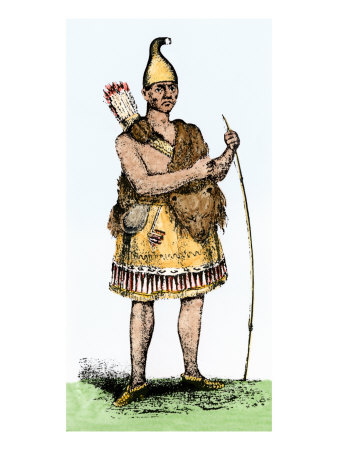
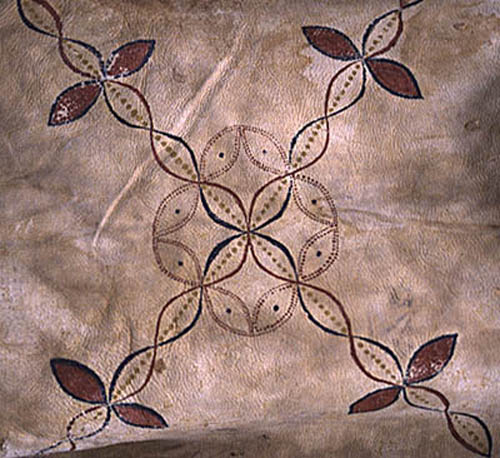
Curious about the Native peoples who once lived along the banks of the Merrimack River? The Lowell Folklife Series invites you to a talk by Dana Benner on Saturday, November 5 at the Event Center of the Boott Mills MuseumWhen most people think of Native peoples at or around the time of contact with Europeans, they think either of Thanksgiving or fierce warfare. Many people are unaware of the extensive social traditions, trade relations, and industrious nature of the Native nations. The area along the Merrimack River that we define as Lowell was home to the Pennacook people.  Just to the south were the Massachusett, who were direct trading partners with the Pennacook.  Mr. Dana Benner will explore the rich traditions of the Pennacook nation, leaving the audience with a greater appreciation of the people who once called this area home.

Dana Benner is of Micmac/Penobscot/Piqwacket descent and is a member of the Inter-Tribal Council of New Hampshire.  He has been studying Native history and culture his entire life and has been writing about it for over 25 years.  He holds a BA in Liberal Arts with a concentration in U.S. History and Native Culture from Granite State College and he is working on his M.Ed in Heritage Studies with a concentration in Native History and Culture from Plymouth State University.

This talk is free and open to the public.

2:00 p.m @ 2nd Floor Event Center, Boott Mills Museum

110 John Street, Lowell, MA

For more information: 978-275-1719

Event sponsored by the Lowell National Historical Park and the Massachusetts Cultural Council.


Scenes from a folk festival

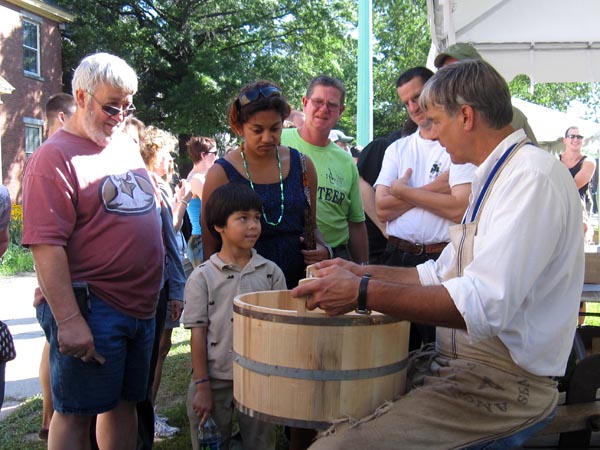
The Lowell Folk Festival is best known for its spectacular array of traditional music and ethnic food. Perhaps less well known is the Folk Craft & Foodways demonstrations that take place every year in the shade of Lucy Larcom Park. From watching fishing flys being tied and seeing how Abenaki baskets are woven, to handling newly constructed Puerto Rican musical instruments, it’s an area that encourages a special kind of hands-on interaction that kids especially enjoy.

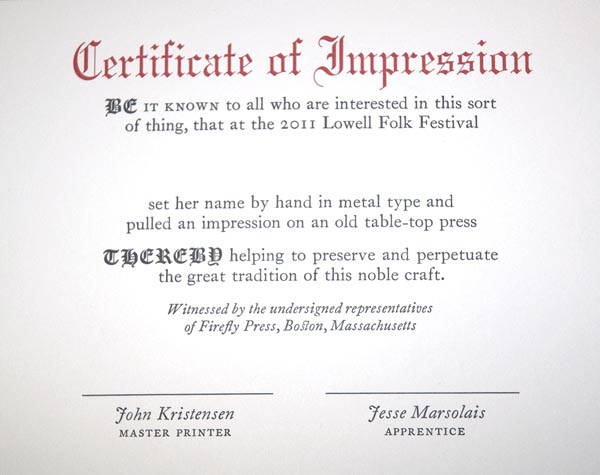
Folks that stopped by the letterpress printing tent got the chance to set metal type in a composing stick and then pull an impression (i.e., print) their own name on a table top  press.

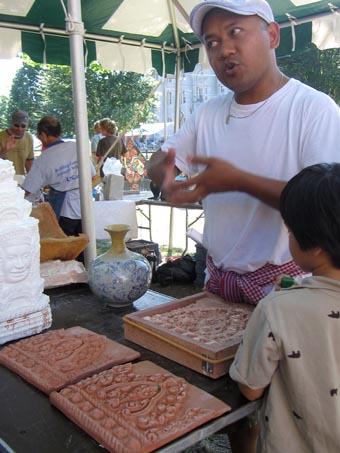
Samnang Khoeun explained the carving and casting ofan element of Cambodian ornamental design known as kbach.

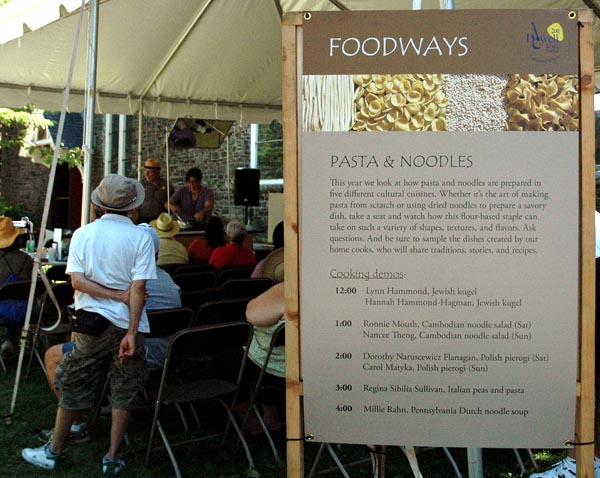
Just across from the craft demonstrations was the large Foodways tent. Here, people had a chance to watch cooking demonstrations and sample noodle and pasta dishes from five different cultural cuisines.

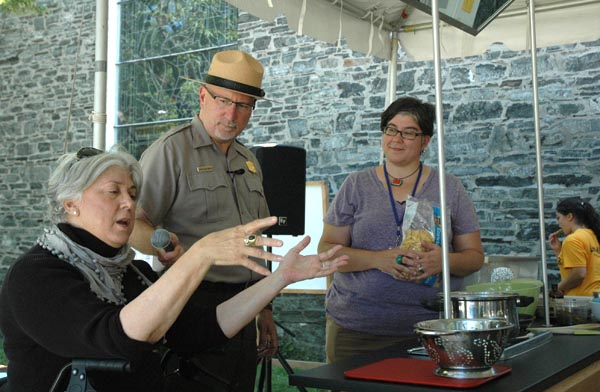
The demonstrations started at noon with Jewish noodle kugel. Hannah Hammond Hagman and her mother Lynn Hammond, shared a recipe which has been handed down in their family for four generations.

Ronnie Mouth shared her mother’s recipe for cold Cambodian noodle salad.

Other dishes that were presented over the weekend included Italian pasta and peas by Regina Sibilia Sullivan, Polish pierogi by Dottie Flanagan and Carol Matyka, and Pennsylvania Dutch chicken corn noodle soup by Millie Rahn. In addition to the welcome shade of the tent, the crowd seemed to enjoy hearing stories about  family traditions, cooking tips, recipes. . .

. . . and those delicious samples!

All photos by Maggie Holtzberg

Life lessons through doll making

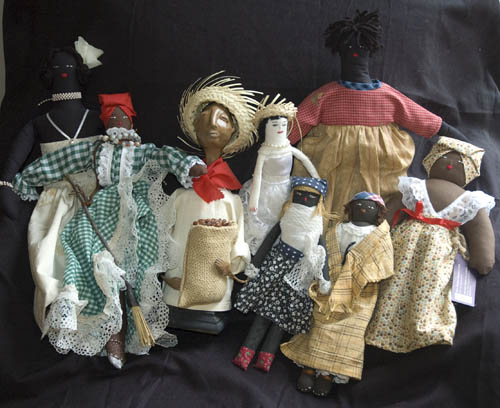
On July 12, 2011, Puerto Rican dollmaker, Ivelisse Pabon de Landron, and her apprentice Jamielette Figueroa will do a demonstration at 2:00 p.m. in the Ashland Public Library. They will be sharing skills passed on during their 9-month Traditional Arts Apprenticeship, which was funded by the Massachusetts Cultural Council.

Among the skills young Jamielette learned are hand sewing, joining seams for clothing construction, drawing, cutting fabric, paper pattern making, use of a thimble, color wheel, tape measure, and sewing machine, preparing fabric, stuffing techniques, shearing for skirts, making hair out of yarn, and hand embroidery. These are things that used to be taught in home economics classes, if not not something that most girls learned firsthand from their mother or grandmother. Nowadays, how many youngsters are adept at sewing?

Perhaps, more importanty, these sewing lessons were steeped in folk cultural context. In addition to working on the technical craft of doll making, Ivelisse made sure that Jamielette learned about the history of Puerto Rico and the folk culture of its people. She came to understand that many of the skills that were passed on from one generation to the next were honed during times of hardship, when many rural people could not afford to buy the necessary things to survive, let alone provide toys for their children. Years ago, mothers taught their daughters the craft of making dolls using socks, old garments, corn husks, and banana leaves. To bring this history to life, Ivelisse and Jamielette created characters from Puerto Rican folkore such as the nana (care taker of children) camadronas (midwives), jibaros (farmers) and African bomba y plena dancers.

Ivelisse was a demanding teacher in the way great teachers are. On occasion, Jamielette did not meet her expectations, turning in a half-hearted job. Ivelisse took the opportunity to teach Jamielette the importance of taking pride in what you do. Through hard work and attention, Jamielette grew to meet Ivelisse’s expecations. It helped that master artist and apprentice share the same heritage, Spanish language, and spiritual faith.

The July 21 public demonstration will serve as a dress rehearsal of sorts for a Ivelisse and Jamielette. They will be joining eight other master artist/apprentice pairs participating in the summer’s Lowell Folk Festival. Come by and see them in the Folk Craft & Foodways area along Lucy Larcom Park on July 29-31, 2011.

Under One Tent: Duck Decoys and Fishing Flys

The Folk Craft area at this summer’s Lowell Folk Festival focuses on the role apprenticeships have played in helping to sustain traditional art in New England. Below are two master artists and their apprentices that will be sharing a tent in Lucy Larcom Park. We are thankful to our friend and collegeague, Lynn Graton of New Hampshire Folklife  for connecting us with these talented craftsmen.

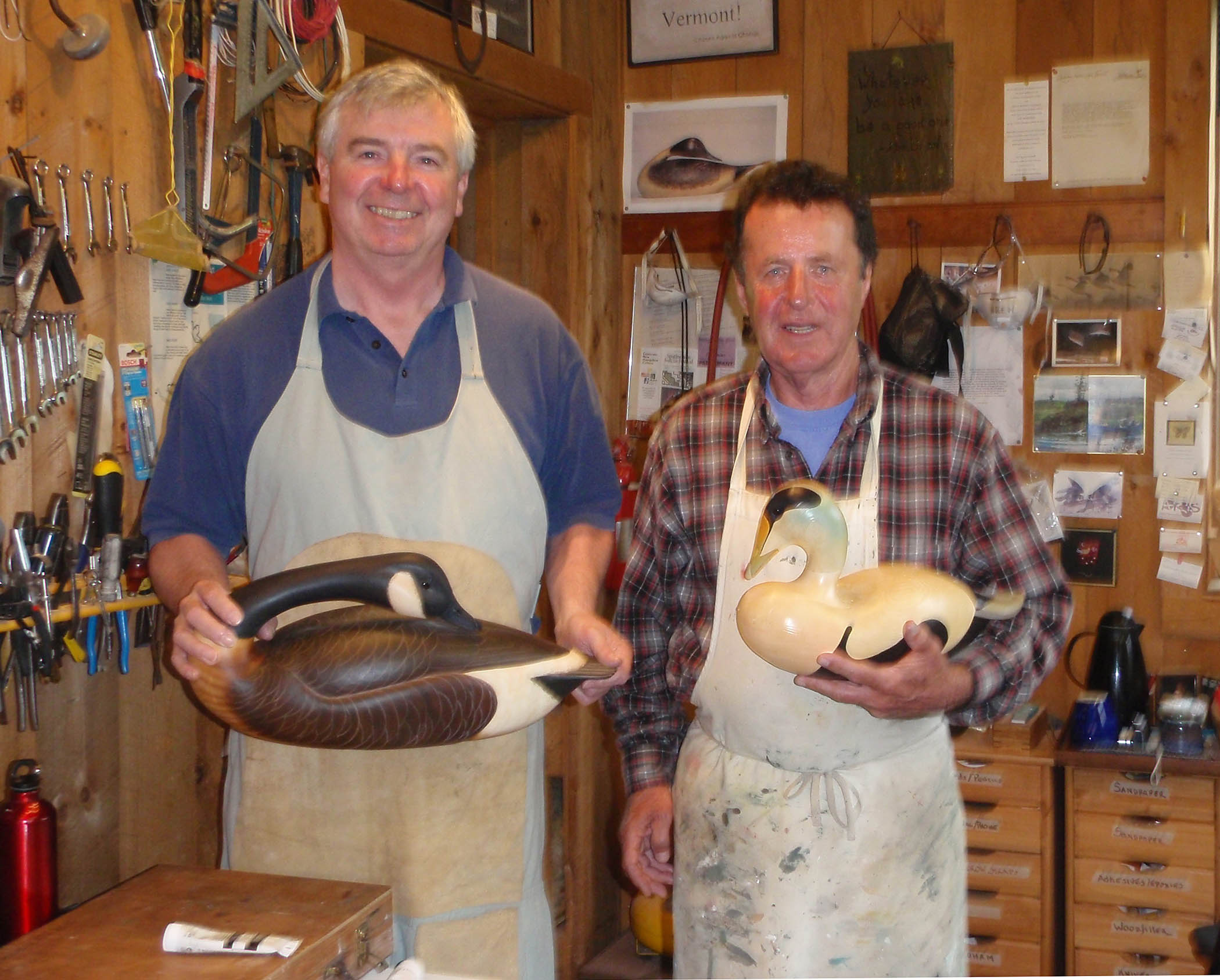
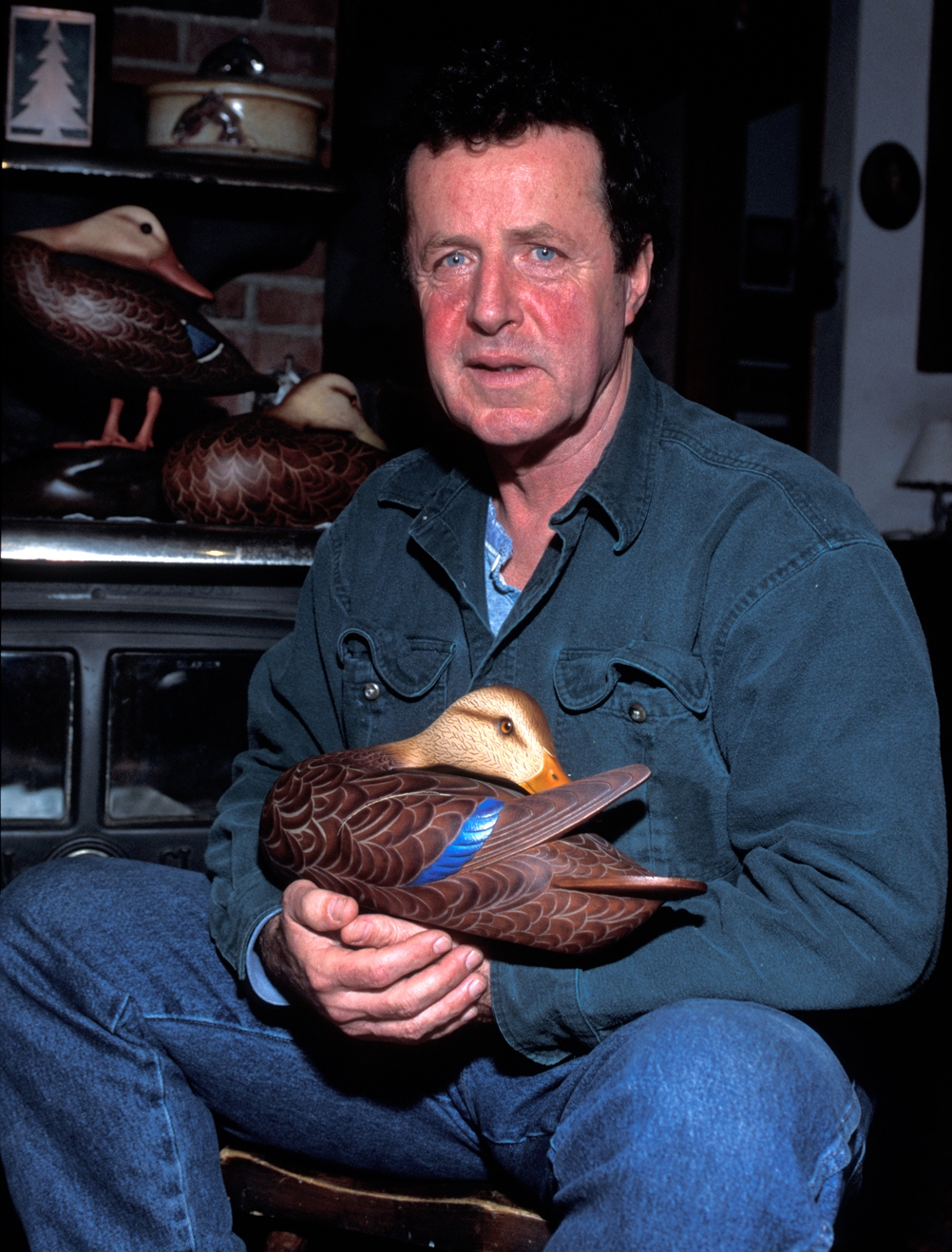
Making a beautiful decoy starts with being a keen observer of wildlife, in order to mimic the postures and grace of a variety of wildfowl and songbirds. Skills in carving must be matched by skills in painting. Layers of carefully applied paint help create the sheen and luster of feathers. Fred Dolan, of Strafford, New Hampshire,is a nationally recognized wood carver, specializing in waterfowl and songbirds. In addition to having studied under master carvers both in New England and in the Chesapeake region, Fred has studied ornithology and  worked with New Hampshire Fish and Game officials to band geese as a way of studying the birds at close range.

Fred works primarily with cedar, basswood or tupelo wood. He uses a variety of techniques such as combing to simulate wavy lines;  stippling to diffuse light and provide texture;  airbrush techniques to create iridescent highlights and shadows;  as well as hand painting of feather details. Gary Trotter is one of several apprentices Fred has mentored through a Traditional Arts Apprenticeship grant awarded by the New Hampshire State Council on the Arts.

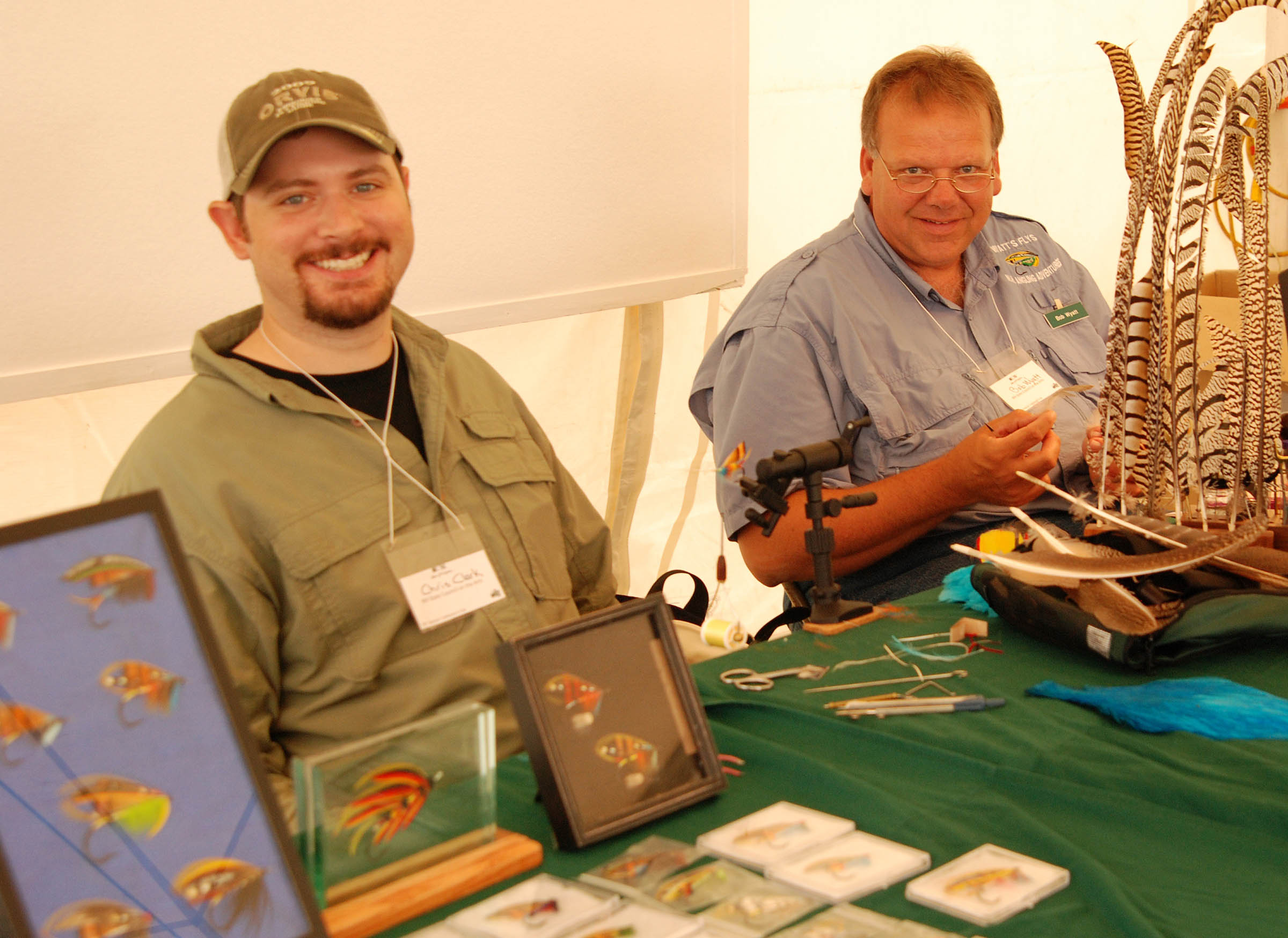
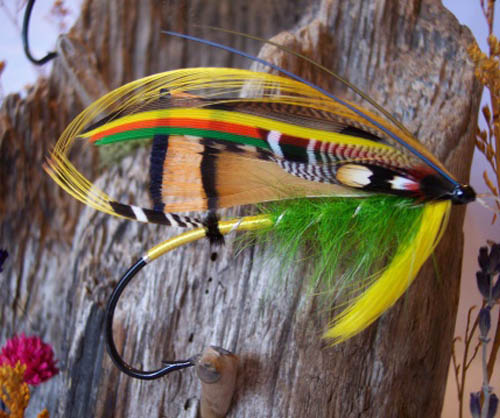
Fly fishing has been around for centuries, but the greatest advancements to the tradition were made in19th-century England. Flys are a combination of feathers, fur, and wire to imitate the look, color, wiggle, and silhouette of a bug or bait for fish. As Lynn Graton writes, “Classic Atlantic salmon flys are considered by many to be the king of the ornamental flys and are collected and displayed for their jewel-like beauty.” With up to 30 or 40 steps and taking several hours to complete, they represent the pinnacle of fly tying art. The distinction between working flys and classic Atlantic salmon flys, with their exotic feathers, is akin to that between working decoys and decorative decoys.


As a child, Bob Wyatt watched his father tie Atlantic salmon flys on family fishing vacations in Nova Scotia. The fly is used to catch “the king of fish,” says Bob, who now preserves fly tying as part of New Hampshire’s outdoor heritage. In 2009, Bob  was awarded a grant from the New Hampshire State Council on the Arts to mentor Chris Clark, who runs an outdoor adventure guide business.

Working Waterfront Festival: Come Celebrate America’s Oldest Industry

Great weather and great programming! We suggest heading down to New Bedford this weekend for the 7th annual Working Waterfront Festival. This year’s theme is All in One Boat: the Cultural Mosaic of New England’s Working Ports

In addition to the focus on cultural diversisty, the festival programming speaks to the common challenges facing fishing communities around the globe, especially in light of recent changes in fisheries management. Come enjoy live maritime and ethnic music, listen to tales from Cape Verdean Longshoremen, try your hand at mending a fishing net, watch a coast guard rescue demonstration, walk the decks of a scalloper, eat fresh seafood, and immerse yourself in an insider’s view of the local industry that brings seafood from the ocean to your plate.

We are happy to see that retired fisherman, Marco Randazzo, who we met years ago in Gloucester, will be demonstrating his knot tying and rope sculptures on Sunday.

Marco Randazzo with some his rope sculptures. Photo by Scott Alarik, 2000.

Crafting Sound: Pipe Organs in the Making

You wouldn’t know from the exterior of this building that inside, magic happens.  C.B. Fisk, Inc., Pipe Organs  in Gloucester, Massachusetts is home to a talented team of craftspeople who build world class pipe organs. Their skills range from the ancient crafts of metallurgy and cabinetmaking to modern computer-aided design. 
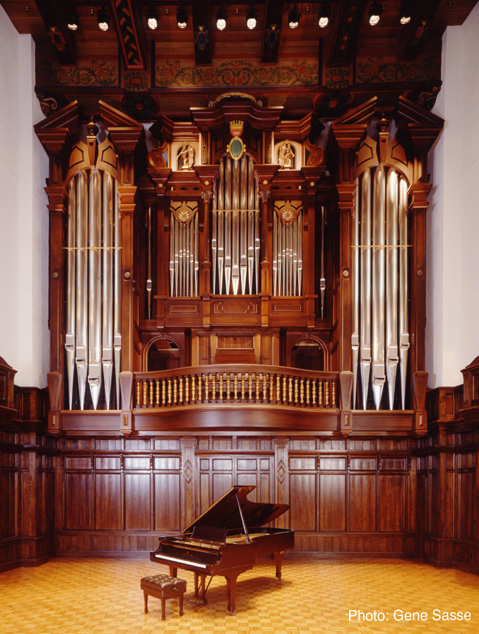
 

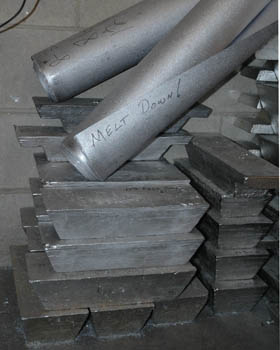
Physicist and organ maker Charles B. Fisk founded the firm in 1961 to build pipe organs with mechanical action, as they were built in the time of J. S. Bach. Fisk organs typically contain thousands of pipes, most made from lead/tin alloys cast into sheets in the company’s workshop.

We visited C.B. Fisk, Inc. recently, where we began our tour with Greg Bover, Vice President for Operations. Here you see him with a 1:16 scale model of Harvard University Memorial Church, one of three current instruments in the process of being built.

It can take anywhere from five months to a year and a half to build a pipe organ And that is just the actual construction on site. Once the organ is taken apart and moved for installation, another five months to a year of tonal finishing work must be done. “That’s when the fun really begins, ” says Greg. “There are over 3,000 pipes that are going to be in this organ. They’ll all be shop-voiced, which means they’ll all be made to work to a level. But when we get to Harvard, each one of those pipes has to be adjusted to the acoustics of the building. The real work of the sonority starts once the thing is installed. Then the voicers go in, in two person teams, and go through every single pipe.”

I marvel at the stunning detail of the working model — the corinthian-like columns, the dental moldings, and the working clock. Greg explains that some rooms really warrant it. Creating a detailed model is “a huge factor in what the organ looks like and feels like. If we had fudged the cornices, it wouldn’t have had the same effect.”


“It’s math. It’s physics. It’s architecture. It’s cabinet making. Metallurgy — all of it. Organ builders — you’ve got to be a jack of all trades.”

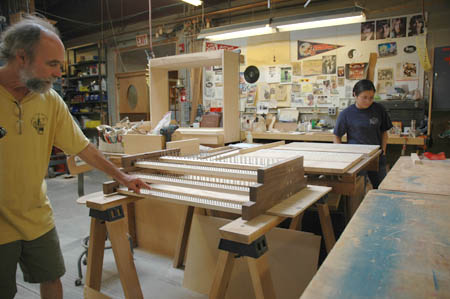
Pipe builder William Finch gives us a tour of the entire company, beginning with the voicing room, where each individual pipe is adjusted until it “speaks properly.” In the wood shop we  watch organbuilder and voicer Nami Hamada working on the keyboard for Memorial Church. 
 

The casting room is where lead and tin are smelted down to form three different alloys. The pure lead has trace amounts of antimony, bismuth, and copper. These impurities stiffen the metal. William explains that harder the metal, the more the overtones are accentuated when air passes through the pipe.
  

We enter the pipe room, greeted by the sound of blues blasting from a boom box. Here several staff members are working on various aspects of fabricating pipes.


Listening to people throughout the shop talk about the process of making pipe organs, it is hard not to notice how the organ’s core parts are attributed with traits of the human body. The pipe has a “tongue,” “body,” and “feet.”  It is said to “speak” and must be voiced properly. The reeds of the pipe sit on a wind “chest.” It’s as if the finished product is a living, breathing, thing.

Homemade musical instruments

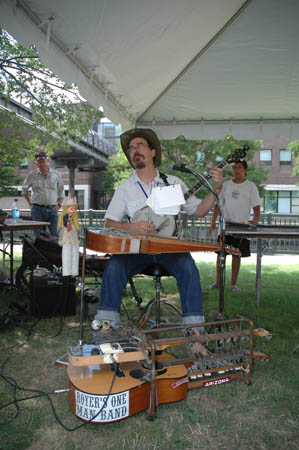
Sharing a tent at this summer’s Lowell Folk Festival, Eric Royer and Robbie Phillips demonstrated their hand made musical instruments as part of the “Crafting Sound” crafts area.

Eric Royer invented the guitar machine in 1994 while living in Arizona, where he found it  difficult to find other musicians to play traditional bluegrass and old-time country music. Eric’s guitar machine features foot-controlled bass and acoustic guitars suspended on a copper pipe frame. Metal can be found in the banjo, resonator guitar (dobro), harmonica, and kazoo. Pedals use mechanical action to cause different effects; capos go up and down, strings are plucked, a golf ball hits the cowbell, and the “Pretty Polly” doll dances.

“Washtub Robbie” Phillips is known for his creation of odd and fanciful musical instruments. The majority of them are mono-chord (single string) instruments called diddley bows. Typically played with a slide, the diddley bow is ideal for improvising.


Robbie got started making instruments years ago when he was dissatisfied with the sound of the washtub bass he was playing and decided to make his own.  He uses recycled materials – pieces of old furniture, blocks of discarded wood, car parts, and left-over paint. The colorful instruments have a unique finish to them. After a base coat of paint, Robbie applies Elmer’s glue over the surface. Before the glue dries, he sprays latex paint, which shrinks upon drying, creating a crackled surface.

Saddles and Sallangs: Working with Leather Fit for a Horse

Ava Vettenberg apprenticed to a Hungarian saddle maker in her twenties. Years later she found herself working with master saddle maker (and former Olympic gold-medalist rider)  Tad Coffin. Now Ava makes her home in Swansea, Massachusetts where she is building a reputation as a skilled saddle maker who breathes new life into worn and broken English saddles. It is a skill born of many years of working with leather and horses. “My master told me that you cannot learn all of this in the time it takes for a candle to burn down.”

At the core of a saddle, underneath the leather padding and synthetic webbing, is a structural unit called a saddle tree. In Ava’s words, “It is the heart, the engine, the center, the base, the frame of a saddle.” A well-built, well-engineered saddle tree needs to be super strong, but also have give. A saddle, as Ava points out, is really “sporting goods equipment between two living beings.”

In one corner of Ava’s shop is a saddle needing repair made by Hermés, the Parisian company known for their haute couture silk scarves. The company still hand-stitches their saddles, however most saddle makers today use machines.

Hand stitching leather requires strong hands and two needles. Ava sits at her “stitching horse” to sew two pieces of leather together, using two needles and an awl. The majority of her tools she inherited from her master, Ferenc Laszlo.


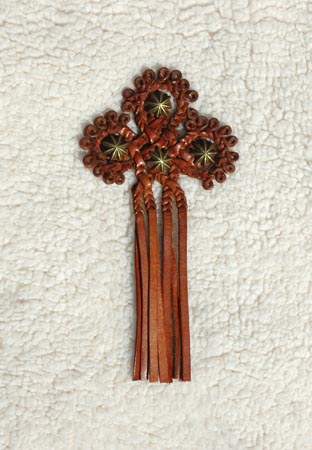
In addition to building and repairing saddles, Ava is a master of the Hungarian art of braiding leather into decorative pieces called sallang. The Hungarian word translates to scrap leather. Originally, horse owners attached leather straps to the harness as a way for horses to fling away flies.

Some 400 years ago in Europe, these functional leather scaps were developed into decorative pieces used to dress up the horse for special occasions. “It was naturally a different culture. There was no airplane, there was no car, there was no telephone. And when a prominent guest or political person came to the town, how did you go to the railroad station to pick them up? With a beautiful pair of horses, or four in hand — two in front, two behind.” 

“Because the working harness is brown or a natural color, getting dusty or dirty, it’s fine when you train the horses. We don’t use decoration. As soon as you dress up your horses for parade, even today, for carriage driving presentation, the Hungarians use these sallang decorations on the harness  One on the forehead, two sideways at the ears and one on the back.” The use of brass ornaments — rosettes, stars, buckles — and painted color initials represent different barns.   


With Ava Vettenburg in our midst, perhaps we will see more horses adorned with sallang and more riders who are truly comfortable in their English saddles.

Changes Afoot …


As the Folk Arts and Heritage Program begins its 12th year at the Massachusetts Cultural Council, we are excited to tell you about some changes. Through a unique partnership with Lowell National Historical Park (LNHP), state folklorist Maggie Holtzberg has been temporarily assigned to the Park to support the development and expansion of traditional arts programming serving the public. We will continue our work in running a vital state folk arts program — doing field research, maintaining an archive, database, and website, and providing grants to individual artists. This new endeavor is an exciting opportunity to explore cross-cultural understanding within in the context of a National Park based on ethnic heritage, occupational folklore, immigration, and industrial history.  


The goal is to engage visitors and more of the region’s immigrant and ethnic populations by offering a robust variety of culturally-relevant public programs at the Park year-round. Though the MCC Folk Arts and Heritage Program has worked with the Lowell Folk Festival for over a decade (providing potential crafts artists and musicians, emceeing on stages, etc.) we will be more actively involved in the planning and presentation of folk arts than ever before. This summer, look for “Folk Craft and Foodways” in Lucy Larcom Park where we will showcase some of the extra-musical aspects of traditional folk culture.

The plan is to build on the energy of the festival — the high-quality, traditional arts performances that are the hallmark of the Lowell Folk Festival — and offer similar experiences throughout the year. Special exhibits and interactive presentations of craft, foodways, performing, and expressive traditions will be developed based on both previous and new folklife field research within the region’s many diverse communities. There is even the possibility of re-establishing a folklife center at the Park.

 Keep your eye on this blog for further postings from Lowell . . .

Local Brick Making and Pottery Industries, circa 1800

Brick making and utilitarian pottery was once a thriving industry in Massachusetts. Come hear Rich Hamelin of Pied Potter Hamelin Redware talk about the people, language, history, materials, and development of brick and pottery making in America from the early Colonial days through the 1930s. Special focus on a who’s who in Massachusetts and Medford (such as the Tufts family) clay working industries. The Program will take place February 24 at 7:30 p.m. at the Medford Historical Society headquarters located at 10 Governors Ave. in Medford.

css.php