Fiddle Heaven

An impressive group of fiddlers from around the country is gathering this week to teach at Boston’s Berklee College of Music for the Mark O’Connor Summer String Program. They represent a wide array of styles, including bluegrass, jazz, Irish, classical, Scottish, blues, hip hop, Texas swing, and more. Best of all, the stellar faculty are performing in a showcase concert Friday night at the Berklee Performance Center. Whether you are a fan of string music or an aspiring musician, this show promises to be full of virtuosity, authenticity, authenticity, and heart.

Free Traditional Irish Dance & Music Performance on June 4


Traditional Irish dance and fiddle music will fill the Merrimack Repertory Theatre on June 4 in a program sponsored by Lowell National Historical Park.

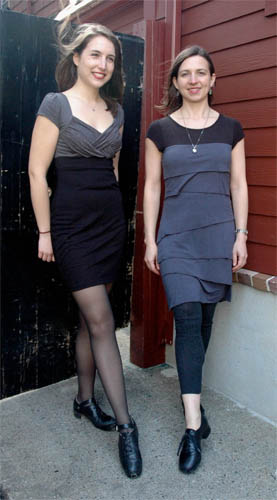
Fiddle player Laurel Martin and step dancers Kieran Jordan and Kevin Doyle are all recipients of 2010 MCC Traditional Arts Apprenticeship grants. These publically-funded grants allowed these artists to provide a year of one-on-one teaching to talented apprentices Natayla Kay Trudeau, Emerald Rae, and Nicole Leblanc.

This free concert presents a unique opportunity for collaboration, as teachers and students come together to present the results of their apprenticeships and insight into their teaching methods.

Come join us for an exciting evening of solo, duet, and group performances revealing the history and shared languages which these artists express, preserve, and pass on.

Place: Merrimack Repertory Theatre, 50 E. Merrimack Street, downtown Lowell

Time: 8:00 p.m.

No tickets required. For more details:  click here

Event presented by Lowell National Historical Park and funded in part by the National Endowment for the Arts, the Massachusetts Cultural Council, and the Southern New England Traditional Arts Apprenticeship Program.

Women’s Singing Traditions: African Praise Songs to Irish Ballads


Join us this Saturday evening for a free concert of Irish and African music featuring two remarkable female vocalists — Aoife Clancy and Adjaratou Tapani Demba. This concert will take place on Saturday March 19, 2011 in the sanctuary of St. Anne’s Episcopal Church in downtown Lowell.

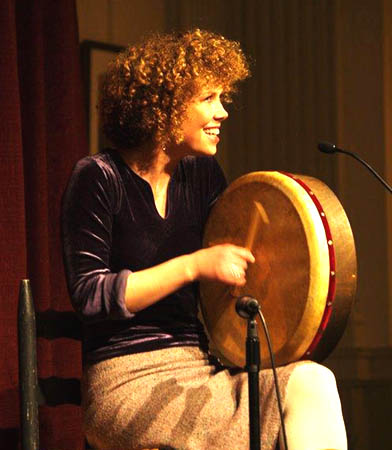
Aoife Clancy brings a refreshing new voice to traditional Irish songs, ballads, and recitations. Originally from County Tipperary, Ireland, Aoife was brought up in a family steeped in music and poetry, which her father Bobby Clancy passed down to her.  She is a former member of the popular “Cherish the Ladies,” one of the most sought-after Irish American groups in history.  Now with seven recordings under her belt in the last decade, Aoife has clearly established herself as one of the divas of Irish folk music. Accompanying herself on the Irish bodhran (drum), Aoife will be joined by Shannon Heaton on flute and  All-Ireland champion stepdancer Jaclyn O’Riley.

Adjaratou Tapani Demba brings us the West African traditional art of praise singing. In her native Mali, she is known as a djeli – a kind of oral historian, peacemaker, and performer who is born into the responsibility of keeping alive and celebrating the history of the Mandé people of Mali, Guinea, and other West African countries. In addition to concerts, Tapani performs at weddings, baptisms, and other domestic ceremonies within the West African immigrant communities of Boston, New York City, and beyond. She will be accompanied by Balla Kouyaté on balaphon (forerunner of the xylophone) and Moussa Diabaté on ngoni (forerunner of the banjo).

The evening’s singing, music, and dance pay tribute to the rich musical heritage of Lowell’s Irish and African communities. The program is part of the recently launched Lowell Folklife Series sponsored by   Lowell National Historical Park.

Working Waterfront Festival: Come Celebrate America’s Oldest Industry

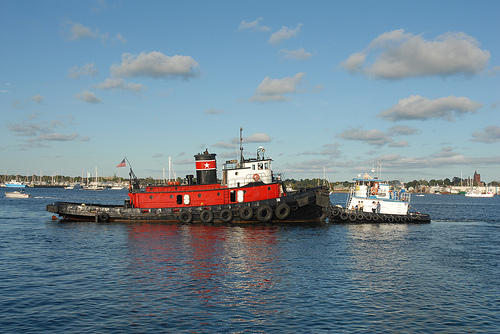
Great weather and great programming! We suggest heading down to New Bedford this weekend for the 7th annual Working Waterfront Festival. This year’s theme is All in One Boat: the Cultural Mosaic of New England’s Working Ports

In addition to the focus on cultural diversisty, the festival programming speaks to the common challenges facing fishing communities around the globe, especially in light of recent changes in fisheries management. Come enjoy live maritime and ethnic music, listen to tales from Cape Verdean Longshoremen, try your hand at mending a fishing net, watch a coast guard rescue demonstration, walk the decks of a scalloper, eat fresh seafood, and immerse yourself in an insider’s view of the local industry that brings seafood from the ocean to your plate.

We are happy to see that retired fisherman, Marco Randazzo, who we met years ago in Gloucester, will be demonstrating his knot tying and rope sculptures on Sunday.

Marco Randazzo with some his rope sculptures. Photo by Scott Alarik, 2000.

Crafting Sound: Pipe Organs in the Making

You wouldn’t know from the exterior of this building that inside, magic happens.  C.B. Fisk, Inc., Pipe Organs  in Gloucester, Massachusetts is home to a talented team of craftspeople who build world class pipe organs. Their skills range from the ancient crafts of metallurgy and cabinetmaking to modern computer-aided design. 
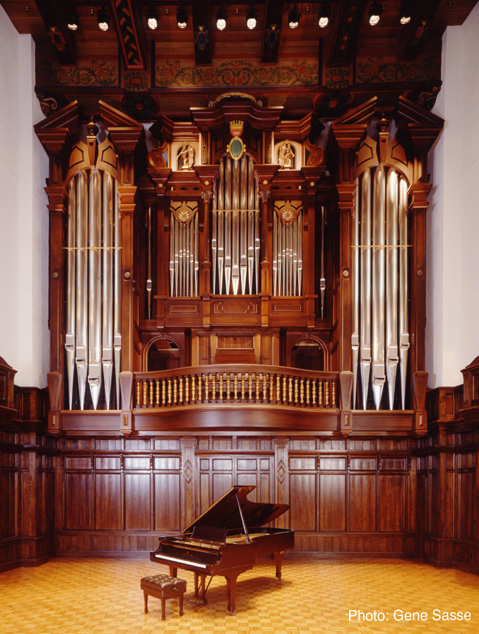
 

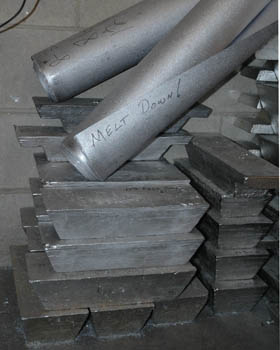
Physicist and organ maker Charles B. Fisk founded the firm in 1961 to build pipe organs with mechanical action, as they were built in the time of J. S. Bach. Fisk organs typically contain thousands of pipes, most made from lead/tin alloys cast into sheets in the company’s workshop.

We visited C.B. Fisk, Inc. recently, where we began our tour with Greg Bover, Vice President for Operations. Here you see him with a 1:16 scale model of Harvard University Memorial Church, one of three current instruments in the process of being built.

It can take anywhere from five months to a year and a half to build a pipe organ And that is just the actual construction on site. Once the organ is taken apart and moved for installation, another five months to a year of tonal finishing work must be done. “That’s when the fun really begins, ” says Greg. “There are over 3,000 pipes that are going to be in this organ. They’ll all be shop-voiced, which means they’ll all be made to work to a level. But when we get to Harvard, each one of those pipes has to be adjusted to the acoustics of the building. The real work of the sonority starts once the thing is installed. Then the voicers go in, in two person teams, and go through every single pipe.”

I marvel at the stunning detail of the working model — the corinthian-like columns, the dental moldings, and the working clock. Greg explains that some rooms really warrant it. Creating a detailed model is “a huge factor in what the organ looks like and feels like. If we had fudged the cornices, it wouldn’t have had the same effect.”


“It’s math. It’s physics. It’s architecture. It’s cabinet making. Metallurgy — all of it. Organ builders — you’ve got to be a jack of all trades.”

Pipe builder William Finch gives us a tour of the entire company, beginning with the voicing room, where each individual pipe is adjusted until it “speaks properly.” In the wood shop we  watch organbuilder and voicer Nami Hamada working on the keyboard for Memorial Church. 
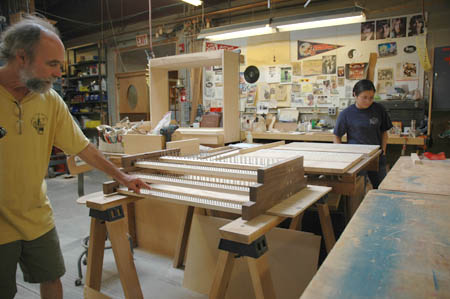
 

The casting room is where lead and tin are smelted down to form three different alloys. The pure lead has trace amounts of antimony, bismuth, and copper. These impurities stiffen the metal. William explains that harder the metal, the more the overtones are accentuated when air passes through the pipe.
  

We enter the pipe room, greeted by the sound of blues blasting from a boom box. Here several staff members are working on various aspects of fabricating pipes.


Listening to people throughout the shop talk about the process of making pipe organs, it is hard not to notice how the organ’s core parts are attributed with traits of the human body. The pipe has a “tongue,” “body,” and “feet.”  It is said to “speak” and must be voiced properly. The reeds of the pipe sit on a wind “chest.” It’s as if the finished product is a living, breathing, thing.

Homemade musical instruments

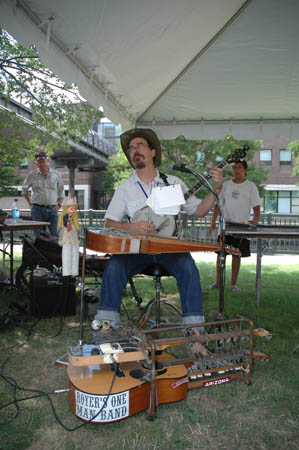
Sharing a tent at this summer’s Lowell Folk Festival, Eric Royer and Robbie Phillips demonstrated their hand made musical instruments as part of the “Crafting Sound” crafts area.

Eric Royer invented the guitar machine in 1994 while living in Arizona, where he found it  difficult to find other musicians to play traditional bluegrass and old-time country music. Eric’s guitar machine features foot-controlled bass and acoustic guitars suspended on a copper pipe frame. Metal can be found in the banjo, resonator guitar (dobro), harmonica, and kazoo. Pedals use mechanical action to cause different effects; capos go up and down, strings are plucked, a golf ball hits the cowbell, and the “Pretty Polly” doll dances.

“Washtub Robbie” Phillips is known for his creation of odd and fanciful musical instruments. The majority of them are mono-chord (single string) instruments called diddley bows. Typically played with a slide, the diddley bow is ideal for improvising.


Robbie got started making instruments years ago when he was dissatisfied with the sound of the washtub bass he was playing and decided to make his own.  He uses recycled materials – pieces of old furniture, blocks of discarded wood, car parts, and left-over paint. The colorful instruments have a unique finish to them. After a base coat of paint, Robbie applies Elmer’s glue over the surface. Before the glue dries, he sprays latex paint, which shrinks upon drying, creating a crackled surface.

In the Community: Music and Franco-American Food


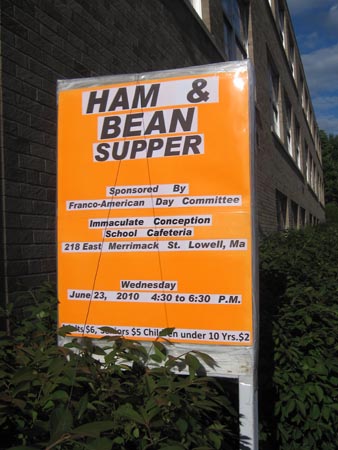
Sometimes, a concert’s setting can make all the difference. When Lowell National Historical Park first thought of partnering with the Franco-American Day Committee to help celebrate Franco-American Week in Lowell, we planned on presenting a Franco-American/Irish concert on Park grounds. But after much thought and discussion, we all realized that the better idea was to pair the Park-sponsored concert with a community event — the traditional ham and bean supper, which is typically held in a French Church Hall. This year, the supper was served in the Immaculate Conception School Hall. When we arrived around 4:45 p.m., the hall was full of people, many of whom had grown up in Lowell and the surrounding communities. Although there were some children about, the average age was about 75. French was being spoken and the aroma was heavenly. Home baked hams and plenty of Cote’s beans, both the light and the dark, were being served.


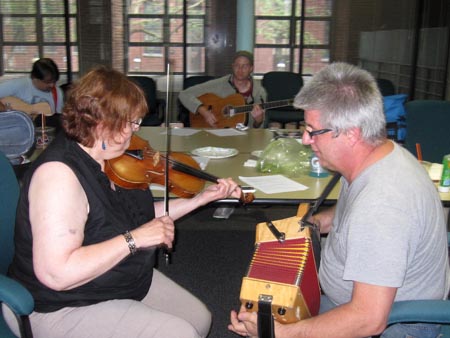
People socialized and ate from 4:30 to 6:30. Music was scheduled to start at 7:30. Several hours before members of the “Irish-French Connection” took the stage, they rehearsed in the Park’s Visitor Center conference room.

The leaders of this band – John Whelan and Donna Hébert –are icons in their Irish and Franco-American musical communities. Each brings 40 years of performing, teaching, and recording experience to the newly formed band.


The tunes and songs they performed during the evening concert were once commonly played and danced to in Irish and French-Canadian immigrant communities throughout the Northeast, where both groups migrated in the 1880s to work in the textile mills. Indeed, when we asked the 135 audience members how many had relatives who had worked in the Lowell textile mills, about half of the hands went up.

Seated at one of the many tables was Lowellian Raymond Breault, who throughout the evening played his wooden spoons and clogged his tap-soled shoes in time to the music. On more than one occasion, he made his way to the front of the hall to demonstrate his rhythmic feet. This delighted the musicians. As Donna remarked from the stage, “There is no better compliment to a fiddler than to have someone who is moved to  get up and dance.”

Franco-American and Irish Tunes in Lowell

John Whelan and Donna Hébert: The Irish-French Connection will perform Wednesday, June 23 at Immaculate Conception School Hall, as part of Lowell’s Franco-American week. The free concert is sponsored by Lowell National Historical Park and Massachusetts Cultural Council as a way of honoring Lowell’s Franco-American and Irish American cultural heritage. Come experience award-winning French-Canadian fiddling, legendary Irish button accordion, brilliant flatpick and fingerstyle guitarists, and powerful songs in Gaelic, English & French.

Icons in their Irish- and Franco-American musical communities, John and Donna spark the Irish-French connection to life onstage! Each brings 40 years of performing and recording experience to this new group. In their stage and educational programs, repertoires and traditions stand distinct and separate and then find themselves blending and reinventing into something new, as did the Irish and French-Canadian immigrant communities in the northeast where both groups migrated in the 1880s to work in the textile mills.

This free concert will take place following the ham and bean supper in the school hall of Immaculate Conception School, 218 E. Merrimac Street, Lowell, MA. Concert at 7:30 p.m. All welcome. Free parking behind school.

Balla goes to Washington

Last time we heard balafon master Balla Kouyaté performing it was at a baby shower in Roxbury, Massachusetts.

From the domestic to the national scene, Balla and his band, World Vision, are being presented by the American Folklife Center at the Library of Congress April 28 as part of their noontime “Homegrown Concert Series”. We will be there with him, introducing this virtuoso balafon player to a DC audience. If you are in the vicinity, come on by. And if you miss the 12:00 o’clock performance, you can catch them at the Kennedy Center’s Millenium Stage from 6:00-7:00 p.m.

Changes Afoot …


As the Folk Arts and Heritage Program begins its 12th year at the Massachusetts Cultural Council, we are excited to tell you about some changes. Through a unique partnership with Lowell National Historical Park (LNHP), state folklorist Maggie Holtzberg has been temporarily assigned to the Park to support the development and expansion of traditional arts programming serving the public. We will continue our work in running a vital state folk arts program — doing field research, maintaining an archive, database, and website, and providing grants to individual artists. This new endeavor is an exciting opportunity to explore cross-cultural understanding within in the context of a National Park based on ethnic heritage, occupational folklore, immigration, and industrial history.  


The goal is to engage visitors and more of the region’s immigrant and ethnic populations by offering a robust variety of culturally-relevant public programs at the Park year-round. Though the MCC Folk Arts and Heritage Program has worked with the Lowell Folk Festival for over a decade (providing potential crafts artists and musicians, emceeing on stages, etc.) we will be more actively involved in the planning and presentation of folk arts than ever before. This summer, look for “Folk Craft and Foodways” in Lucy Larcom Park where we will showcase some of the extra-musical aspects of traditional folk culture.

The plan is to build on the energy of the festival — the high-quality, traditional arts performances that are the hallmark of the Lowell Folk Festival — and offer similar experiences throughout the year. Special exhibits and interactive presentations of craft, foodways, performing, and expressive traditions will be developed based on both previous and new folklife field research within the region’s many diverse communities. There is even the possibility of re-establishing a folklife center at the Park.

 Keep your eye on this blog for further postings from Lowell . . .

css.php