Fiddle or Violin? Meet a Maker

It is a question we hear all the time — what is the difference between a violin and a fiddle? It depends on what style of music someone plays, but basically, they are the same instrument. Chunk Dingle, a country guitar player from Georgia put it this way: “A violin has strings on it; a fiddle has straangs on it.” Classical musicians tend to call their instruments violins, but they sometimes refer to them as fiddles. Players of bluegrass, old-time, and contra dance tunes are more likely to call their instruments fiddles.

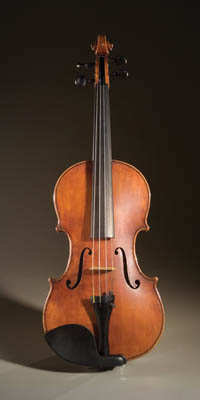
The violin pictured here was made by Bob Childs and it is currently on display at the National Heritage Museum, as part of the exhibition “Keepers of Tradition: Art and Folk Heritage in Massachusetts.” This Saturday, from 1:00-3:00 pm, Bob is going to demonstrate various aspects of violin making. You can ask questions, watch Bob measure, sand, chisel, and carve, and then go take a look at the finished product.

How do those folk festivals get booked anyway?

If you’ve ever been to the Lowell Folk Festival, the American Folk Festival in Bangor, Maine, or the Smithsonian Folklife Festival on the nation’s mall, you might wonder how particular musicians or craft artists get chosen to participate. Folklorist Chris Williams writes of his experience planning a portion of the 2008 Richmond Folk Festival here. It’s a good read. And so are the other essays you can find posted on the Mid Atlantic Forum. The Mid Atlantic Arts Foundation initiated this series to further the exchange of information and ideas among folklorists and their peers. Sally Van de Water, who curates the series, served as city folklorist for Boston back in 2003.

New England Country & Western Music

We are pleased to post a guest blog by Cliff Murphy, folklorist at the Maryland State Arts Council and co-director of Maryland Traditions. While a graduate student at Brown University, Cliff interned with us. In 2008 he received a Ph.D. in Ethnomusicology from Brown University, where he wrote a history and ethnography of New England Country & Western music.

.

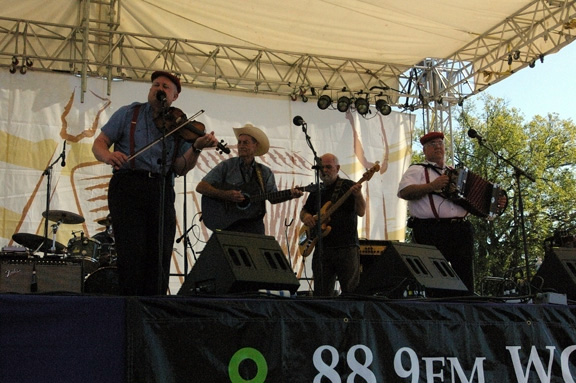
On any given weekend night, head out to the Canadian-American Club in Watertown, Massachusetts and you’ll find the unmistakable sound of New England Country & Western music. Honky-tonk steel guitar blends with Acadian twang and the occasional song that alternates verses sung in French and English. The house band – the Country Masters – and the lead vocal of singer Jimmy Spellman will remind you of Nova Scotian country star Hank Snow – or, better yet, Maine’s legendary truck-driving songster Dick Curless. And the community that gathers here – a community predominating in immigrants from maritime Canada or their descendants – never questions the authenticity of its country musicians.

Yet in the popular imagination, Country & Western music is firmly rooted in the American south, an expression of Protestant, white, working-class Southerners. A scan of modern Country radio reveals song after song with a deep southern twang in the vocals – even when it comes from Massachusetts natives like Jo Dee Messina of Holliston.

So what do we make of the fact that Country & Western has been a rich and vibrant form of multicultural working-class expression going all the way back into the 1920s? And, perhaps even more puzzling is how we come to grips with the fact that Massachusetts has been a hotbed of cowboy yodeling for just as long – a place where women like Georgia Mae Harp of Carver, Kenny Roberts of Athol, Vinny Calderone of Everett, and Johnnie White (Jean LeBlanc) of Stoneham have been yodeling their troubles away for the better part of a century?

As a graduate student in ethnomusicology at Brown University in 2003, I had the good fortune of landing an internship with Maggie Holtzberg – folklorist extraordinaire and editor of this blog – who encouraged me to find the answers to these questions, and even accompanied me on fieldwork visits with a few of the abovementioned yodelers. What emerged over the next four years of fieldwork throughout New England was a picture of Country & Western music as a deeply expressive form of multicultural working-class culture.

The highly ornamented, virtuosic yodel of cowboy music (as opposed to the “blue yodel” of Mississippi Brakeman Jimmie Rodgers) can be traced directly to the farms and lumber camps of Maritime Canada and Maine. An intensely personal form of expression, men generally developed their yodel while working alone with animals – driving teams of oxen in the Maine woods, or driving apples to market in Nova Scotia’s Annapolis Valley. Continue reading “New England Country & Western Music”

Historic New England’s take on folk art

Folklorist Millie Rahn alerted us to two upcoming programs offered by Historic New England (formerly the Society for the Preservation of New England Antiquities) which focus on folk art, material culture and collecting. She writes, “Although the perspectives are different from how folklorists look at this material, the collections are superb and the settings ooze sense of place.” We couldn’t agree more.

The Folk Art Immersion Weekend takes participants on four days of tours and lectures featuring superb collections and top experts. Explore the origins of Folk Art, paintings, hooked rugs, painted furniture, redware, and the many other objects often referred to as “country arts.” This program runs from Thursday, May 14 – Sunday, May 17, 2009.

New England Studies is an intensive week long course running Monday, June 15 – Saturday, June 20, 2009. This annual course on New England architecture, decorative arts, and material culture is conducted by the leading experts in their respective fields. Three scholarships are available to graduate students and mid-career museum professionals.

Recorded sound from so long ago

It’s chilling to listen to – the actual voice of Fountain Hughes, a former slave from Charlottesville, Virginia, whose grandfather belonged to Thomas Jefferson. Remarkably, the Library of Congress has a recording of an interview done with Mr. Hughes as part of a WPA project to record oral histories and interviews with African Americans who endured slavery. The American Folklife Center recently broadcast a podcast that brings to this first-person account to life.

Keeping Digital Media Safe

Have you made the move from slides to digital images? Or from audio tapes to compact flash drives? Do you think about how best to ensure the safety of these “born digital” multimedia files? They seem so ephemeral . . .

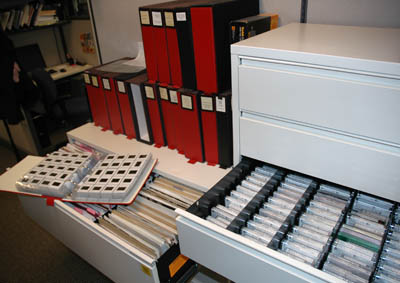
Until fairly recently, folklorists only had to deal with the preservation of tangible field-recorded materials. Here at the MCC, our traditional arts archive is primarily made up of physical things (negatives and slides, printed photographs, magnetic audiotape, and printed matter) that take up space on shelves or in file cabinet drawers. Best practices for preserving and providing access to these types of materials were established long ago (e.g., acid-free paper, climate and humidity control, archival sleeves for slides and negatives). But standards are still being debated for the preservation of digital objects.

Advances in technology have brought us a whole new generation of affordable field-recording equipment which is smaller, lighter, and simpler to use. We can record an interview using a teensy digital recorder that captures sound on a compact flash card. We come back from the field and transfer images from a digital camera onto a computer or external hard drive, with no wait for developing or processing. The images and recordings are instantly accessible for review, editing, and posting on the web. Storage takes up much less physical space. Yet, when it comes to preserving these digital multimedia files, there is something unsettling about moving away from the physical film or magnetic tape. How do we ensure precious digital materials will be accessible over time?

With issues of this sort on my mind, I was fortunate to attend a workshop on preserving digital multimedia files last week at the Vermont Folklife Center. In fact, folklorists around the country expressed their disappointment in not being able to attend. Andy Kovolos, the center’s archivist, shared tips on the basics of digital preservation, including file formats for storing digital photographs and audio, the challenges presented by digital video, and ways to keep good track of your materials.

So, here are a few takeaways:

Multiple copies of files in varying formats keeps material safe. For example, store a recent field recording or photo shoot in several places: on a server, on two external hard drives, and on a CD.

Don’t write on a CD! The top surface of the CD is susceptible to damage, not just the bottom. If you must, write with a water-based, permanent pen on the inner plastic circle of the CD. Avoid “sharpies” as they might interfere with the top (lacquer) layer of the CD.

Store CDs in regular sized jewel cases, not fiberglass or paper sleeves. Store them vertically, not horizontally. Buy CDs in jewel cases, not in spindles.

Migrate, migrate, migrate. Dale Hecker of Harvard University Libraries reminds us that “Digital materials are surprisingly fragile. They depend for their continued viability upon technologies that undergo rapid and continual change.” This is true for analog as well as digital materials. Afterall, who can use a floppy disc anymore, let alone play a wax cylinder or a 78 recording? If your archive is full of DAT (digital audio tape) recordings, as ours is, make sure you copy them onto the latest technology and back them up on a server. Scan slides and create TIF files as your preservation master files. Then create “use” files for editing, printing, and emailing.

Metadata matters. It is important to include information about the information that has been collected. Describe the context, content, format, and authorship of the material. Who conducted the interview, where, and when? Is this interview part of a project or collection? What kind of camera, microphone, or sound recorder was used? What software? Is the material restricted in any way?

The Watershed Years of Public Folklore

The American Folklore Society has been around for over a century. As one might imagine, members include folklorists who work in academia, researching, teaching, and publishing. But during the last 35 years, a growing number of folklorists work in the public sector as state folklorists, museum curators, archivists, radio hosts, and festival producers. What paved the way for strong work in public folklore? Key legislation, the development of programs at several federal cultural institutions, and the vision and perserverance of a few movers and shakers — people like Archie Green, Bess Lomax Hawes, Richard Kurin, Alan Jabbour, and Dan Sheehy. A film project that captures this watershed moment is now availabe online. US Public Folklore: The Watershed Years covers The Early Years and the Smithsonian Festival, Archie Green’s stories about lobbying for the Folklife Preservaton Act and the folk arts programs at the National Endowment for the Arts and the Library of Congress. The project was funded by the National Endowment for the Arts and produced by the Public Programs Section of American Folklore Society.

Surviving Pol Pot and the Power of Art

Daily news of the tribunal proceedings in Phnom Penh, Cambodia are a grim reminder of the atrocities that took the lives of an estimated 1.7 million Cambodians during the Khmer Rouge. One can only imagine how the testimony of those responsible for afflicting war crimes is affecting those who survived unspeakable conditions.

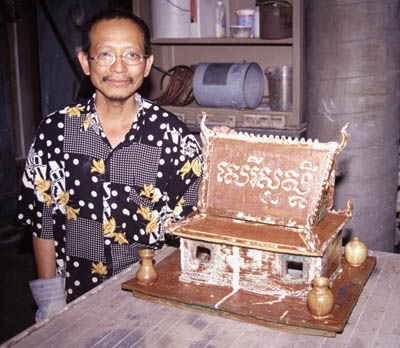
While the making of art is a life force for the majority of traditional artists I’ve met, it is rarely as dramatically a matter of life and death as it has been for Yary Livan. A Cambodian master ceramicist, Livan, the sole survivor of his generation of artists, trained in traditional Khmer ceramics at the Royal Academy of Fine Arts in Phnom Penh, Cambodia. Forced to hide his education to survive under the Khmer Rouge, it was ironically his knowledge of traditional wood-burning kilns that saved him from certain starvation.

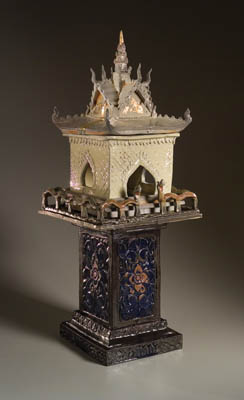
In 2001, Yary and his wife emigrated to Massachusetts. With support from leaders in the local Cambodian community and the arts education community, Yary was able to set up a studio. In no time, he began producing a surprising amount of work — flower vases, elephant pots, and spirit houses.

Sally Reed, a graphic artist who had befriended Livan, stopped by his studio one day and was overwhelmed by the amount of work he had ready for firing. It seemed to her the production of three or four full-time potters. She wondered, “how could one man do this?”

Yary answered her seriously: “In Pol Pot time, I work like an animal. An animal with fear. Now, I work like an artist. In Pol Pot time, my art spirit was almost dead. Now my art spirit is big, is strong, is on fire!”

You can listen to Yary’s story as told in this audio stop, produced by Acoustiguide for the exhibition.

Put some authenticity into your St. Patrick’s Day celebrations

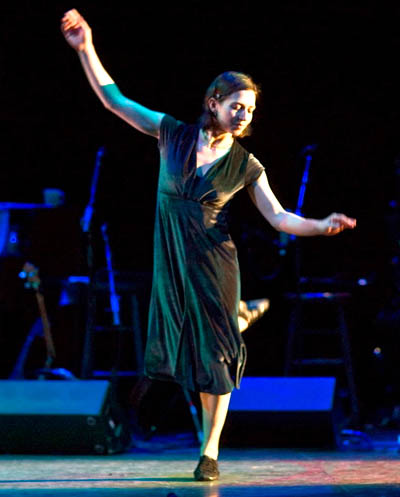
As one might imagine, Kieran Jordan is busy dancing this week and next. For a listing of her upcoming performances, click here. Jordan received an MCC artist fellowship in the Traditional Arts in 2008.

Folk Traditions Flourish in Norway

Successive waves of immigration have always been a source of America’s vitality. Areas with high concentrations of specific ethnic groups often hold rich centers of traditional arts activity. If one were looking into Norwegian American culture, it would make sense to go to the upper Midwest. But I recently discovered a micro-community of people passionate about Norwegian folk dance and music right here in New England. There are regular folk dances where people swirl in elaborate folk costumes. Devotees from Vermont to DC attend summer camps and immerse themselves in springars, gangars, and hallings (traditional dance forms). And surprisingly, many of these individuals were not born into this tradition but rather discovered it as one one might pursue swing dancing, knitting, kayaking, or raising show dogs. A few dancers and fiddlers can claim the cultural heritage passed down to them through their genes, but many devotees of Norwegion folk culture are not of Norwegian heritage.

During the late 19th and early 20th centuries, work in the fishing industry drew large numbers of Norwegians to the southeastern Massachusetts towns of New Bedford, Fairhaven, and Dartmouth. By the 1930s, New Bedford had a thriving Norwegian community that quickly rose to command the scalloping industry, owning most of the boats and processing plants. Many of these people emigrated from Karmoy, an island off the coast of Bergen. Today, there is a great cultural pride and an enduring sense of national identity among the area’s older generation of Norwegian Americans. However, there seems to be a general concern that the young people aren’t interested in their heritage or in learning traditional skills. Though the Norwegian craft traditions of rosemaling , cutwork embroidery, and knitting can still be found amongst descendants of Norwegian immigrants, the hardanger fiddle tradition – if it ever existed here — has died out. Sadly, many of the old timers passed away without passing on their music.

On a recent vacation, I discovered that, in the home country, Norwegian folk traditions continue to thrive. Maybe it has something to do with the long, dark, cold winters. Or Norway’s geography – the spectacular yet isolating terrain of mountains, valleys and fjords. Whatever it is, folk culture is alive and well in Telemark, Norway. Even in this age of iTunes and Facebook, regional styles of dancing, fiddling, and adornment remain in tact.

Couples dancing to a single fiddler playing a hardanger is a common social activity. And young musicians continue to learn from master players in weekly spelemannslags.

Regional and national competitions called kappleleiks are well attended by dancers, musicians, and singers. Musicians are careful to acknowledge whoever taught them a particular tune. Many of the fiddle tunes have stories associated with them.

Rosemaling (Norwegian rose painting) embellishes wooden surfaces of all kinds — furniture, cabinetry, walls, fiddles.

Rosemaling, in the form of embroidery, adorns clothing as well — even undergarments. Dancers literally wear their cultural pride on their sleeves. The traditional folk costume, known as a bunad, varies from district to district and identifies a dancer’s home region.

The hospitality of Norwegian locals and their generosity in sharing traditions was heartening. Being there reminded me of what led to my becoming a folklorist in the first place.

All photos except first one by Maggie Holtzberg.

css.php