Women’s Singing Traditions: African Praise Songs to Irish Ballads


Join us this Saturday evening for a free concert of Irish and African music featuring two remarkable female vocalists — Aoife Clancy and Adjaratou Tapani Demba. This concert will take place on Saturday March 19, 2011 in the sanctuary of St. Anne’s Episcopal Church in downtown Lowell.

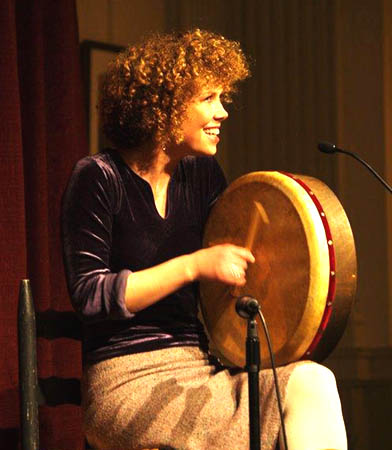
Aoife Clancy brings a refreshing new voice to traditional Irish songs, ballads, and recitations. Originally from County Tipperary, Ireland, Aoife was brought up in a family steeped in music and poetry, which her father Bobby Clancy passed down to her.  She is a former member of the popular “Cherish the Ladies,” one of the most sought-after Irish American groups in history.  Now with seven recordings under her belt in the last decade, Aoife has clearly established herself as one of the divas of Irish folk music. Accompanying herself on the Irish bodhran (drum), Aoife will be joined by Shannon Heaton on flute and  All-Ireland champion stepdancer Jaclyn O’Riley.

Adjaratou Tapani Demba brings us the West African traditional art of praise singing. In her native Mali, she is known as a djeli – a kind of oral historian, peacemaker, and performer who is born into the responsibility of keeping alive and celebrating the history of the Mandé people of Mali, Guinea, and other West African countries. In addition to concerts, Tapani performs at weddings, baptisms, and other domestic ceremonies within the West African immigrant communities of Boston, New York City, and beyond. She will be accompanied by Balla Kouyaté on balaphon (forerunner of the xylophone) and Moussa Diabaté on ngoni (forerunner of the banjo).

The evening’s singing, music, and dance pay tribute to the rich musical heritage of Lowell’s Irish and African communities. The program is part of the recently launched Lowell Folklife Series sponsored by   Lowell National Historical Park.

Calling Track and Military Cadence Calls: How an African American Tradition Influenced Military Basic Training

Ever since the industrialization and mechanization of labor, there has been less need for the singing of work chants. But back in the day, a special kind of singing helped work get done, whether it was sea chanties used to raise sails, Scottish waulking songs used to work wool, or agricultural work chants to hoe cotton or cut timber. In the deep south, such work chants were common among African Americans who labored under extremely harsh conditions. A good song was like a labor saving device. Singing work chants helped coordinate movements and build on collective strength. They also ensured safety for railroad gangs working in small crews with heavyand sharp tools. And, perhaps more importantly, these chants uplifted the men’s spirits.

One man, known as the caller, would stand aside from the crew and sing verbal instructions. His commands were answered by the men’s lining bars wrapping in rhythm against the railroad track– in a call and response manner. I came to know this tradition (or what remained of it in the minds of retired railroad workers) first hand while doing field research for the Alabama State Council on the Arts in the late 1980s. We interviewed half a dozen former track laborers and eventually produced the film Gandy Dancers, which tells the story of African American railroad workers who made their living building and maintaining the railroad lines that crisscross the American South.

I recently uncovered a connection between the southern African American tradition of call-and-response works songs and  military cadence calls used in drill training, popularly known as “Jody calls.” Anyone who has gone through basic training is familiar with these military cadence calls. A drill instructor, whose job it is to keep recruits in step while training, calls out marching orders. Cadence calls motivate, while ensuring unit cohesion and promoting military discipline. Safety is a factor as well, especially while marching or running in close formation. Similar to the railroad workers’ calls, military cadence calls are also a way to take one’s mind off strenuous tasks, vent dissatisfaction, mock one’s superiors, or build morale by boasting, poking  fun, or talking dirty. As verbal art forms, both have a rich tradition.

Popular legend holds that that Private Willie Lee Duckworth Sr. (1924-2004) made up “Sound Off”, a.k.a., the “Duckworth Chant,” which is used to this day in the U.S.Army and other branches of the military.  The year was 1944 and Duckworth was stationed at Fort Slocum, New York as one of eight “Colored Infantrymen.”

Duckworth, who was born in 1924 in Washington County, Georgia, would have been familiar with the use of work chants sung for all kinds of agricultural work. He was also the same generation of the gandy dancers who used chants to line track. At the time he was drafted to serve in WW II, Duckworth was working in a sawmill. He was sent to a provisional training center in Fort Slocum, N.Y., in March 1944. As the story goes, Duckwork, on orders from a non-commissioned officer, improvised his own drill for the soldiers in his unit. Soon after, all the ranks were buzzing and keeping rhythm. Col. Bernard Lentz, who was the base commander at the Fort, approached Duckworth and asked where he developed his unique chant. “I told him it came from calling hogs back home,” Duckworth said. “I was scared, and that was the only thing I could think of to say.”

Colonel Bernard Lentz was so convinced of the cadence calls’ effectiveness that he made them standard at Fort Slocum and went on to write a drill instruction manual.  The “Duckworth Chant” was popularized in 1945 when the US government included it with other popular music of the day on a  V-disc (12 inch vinyl 78 recording) for distribution to US military personnel overseas. The chant later gained fame as “Sound Off” and remains one of the most popular marching cadences in Army history.

Join us at a free public program on February 27 at Lowell National Historical Park Visitor Center. In addition to screening the documentary Gandy Dancers, we will play the original recording of the “Duckworth Chant,” screen contemporary examples of cadence calls, and present a live demonstration by a military drill sergeant.

Mexican Chocolate Traditions in Massachusetts

Back in November, we introduced you to Taza Chocolate and promised you more info on an upcoming public program at Lowell National Historical Park.  Well that day has come. Tomorrow, in the Park’s Visitor Center, we are presenting on Mexican chocolate traditions here in Massachusetts.

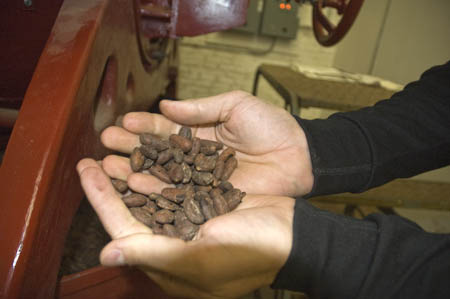
Alex Whitmore, co-founder of Taza Chocolate, will talk about his Mexican-inspired, stone ground chocolate company located in Somerville. Taza manufactures minimally processed chocolate made from fair trade organic cacao beans. Rotary stone mills imported from Oaxaca are used to grind the roasted beans. Each one is hand chiseled with a pattern specifically designed for grinding chocolate.

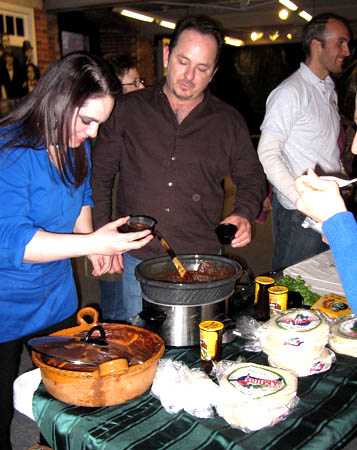
Ricardo and Maria Candiani, owners of Mr. Jalapeno in downtown Lowell, grew up in Hermosillo, Mexico. They will share recipes and traditions passed down within their respective families. These include mole, a sauce made from finely ground ingredients, including chocolate. Delectable samples will be available at this free program, which is sponsored by Lowell National Historical Park. Saturday, February 12, 2011 at 4:00 p.m. at the Visitor Center, 246 Market Street.

Come join us to hear stories and taste samples of Mexican style chocolate and chicken mole. This free program takes place Saturday, February 12, 2011 at 4:00 p.m. at the Visitor Center, 246 Market Street.

Click here to watch the program.


Tables turned: Whose traditions need explaining now?

Often, in our work as folklorists, we meet immigrants from various parts of the world who have resettled in the United States. Our impulse is to focus on their cultural traditions — the music, dance, crafts, and annual celebrations they left behind and how they are managing to hold onto them while making their home in a new and foreign land.

It shouldn’t come as a surprise that new immigrants would also wish to fit in, to understand what holdiays are celebrated here in America, what foods are typically served, or why certain decorations perennially appear.  Why is everybody roasting turkeys? What’s up with all the lights?  Who is the bearded guy in the big red suit? And why is everyone fixated with buying gifts?

And I suppose it’s also not surprising to learn that here in Lowell, within the Cambodian community, some believe that part of becoming “American” is learning to celebrate Thanksgiving and Christmas. With the blurring of religious beliefs and commercialism, one can hardly blame them.

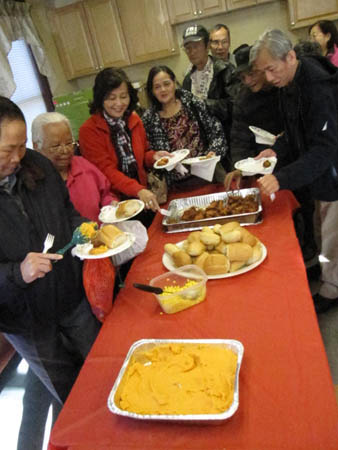
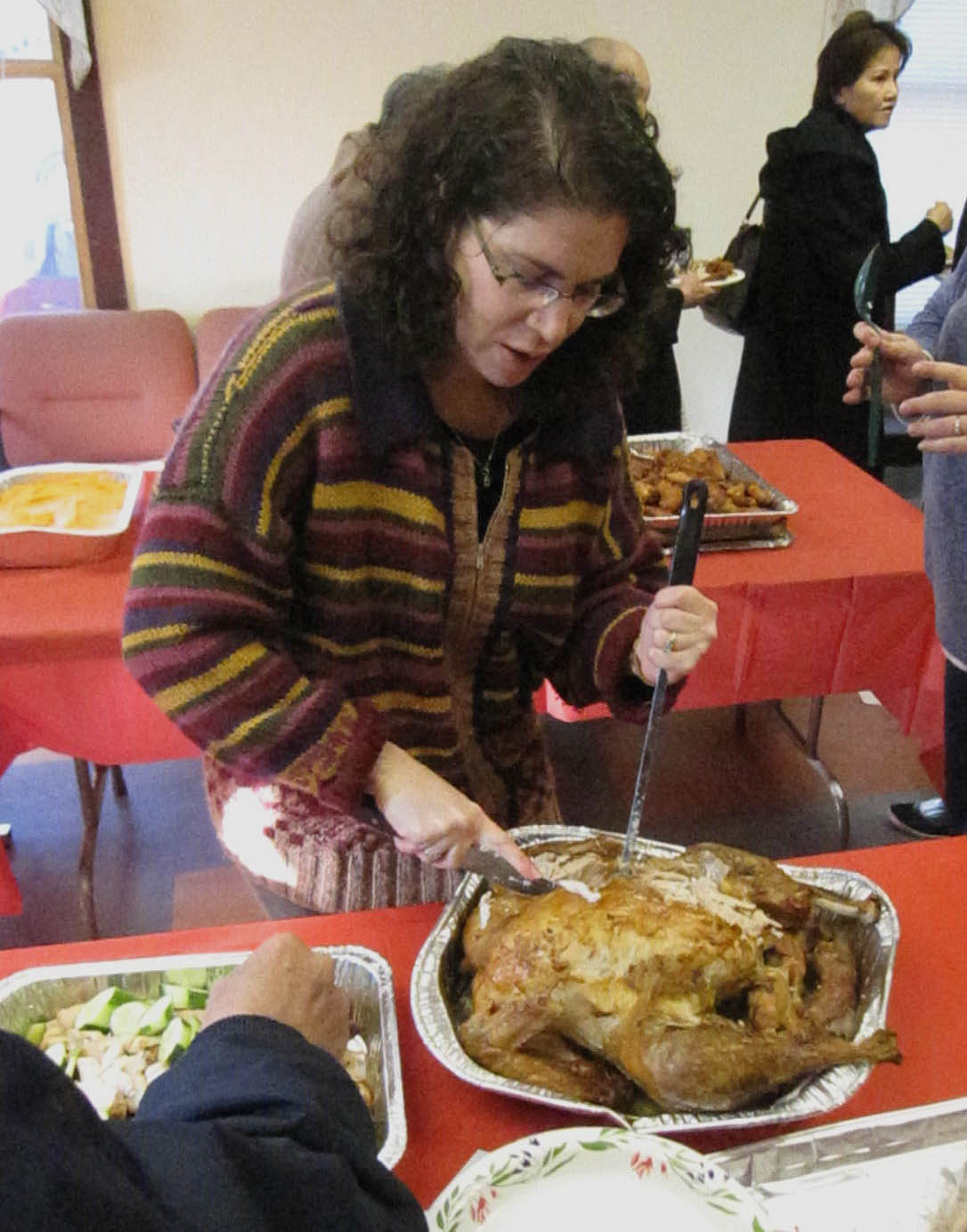
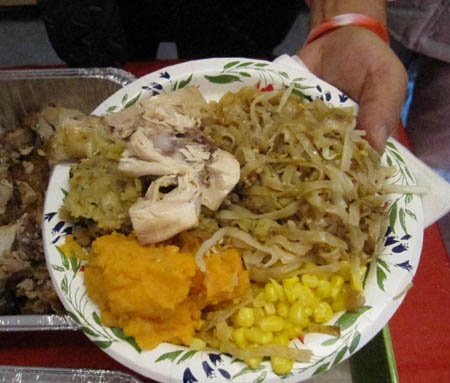
Along these lines, we were asked to address a group of Cambodian elders that were gathering at the  Coalition for a Better Acre for a holiday program. Everyone seemed to enjoy the lunch, which was a fitting mix of American and Asian dishes: roast turkey, sweet potatoes, corn, pickled mustard with pig ears, pad thai, and rice.

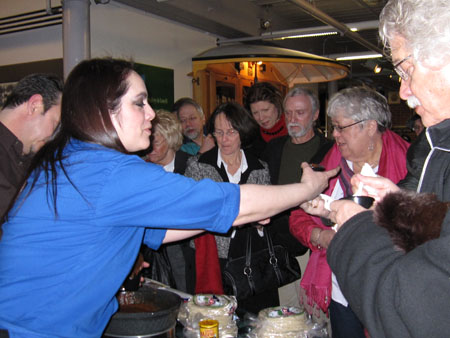
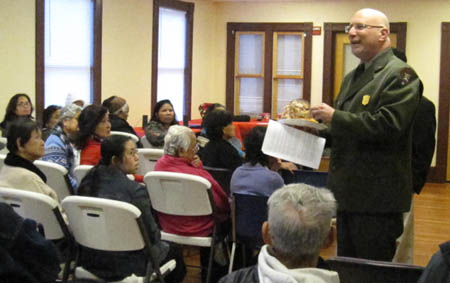
We had hosted some of these same Cambodian elders for a tour of Lowell National Historical Park in September. This time, we were meeting on their territory. CBA invited us to lunch and requested that we briefly explain the history and customs of Thanksgiving and Christmas to the mostly non-English speaking audience. David Blackburn did the honors, seen below holding a plate of turkey and sweet potatoes.

Turns out that hardly anyone in the audience was familiar with the Thanksgiving holiday. Christmas, on the other hand, many were aware of — and it would be difficult not to be, given how pervasive the marketing of the holiday is and the fact that schools and businesses are closed on December 25th. One man asked in Khmai, “What is the purpose of Christmas?” David offered this answer, “It depends on who you are.  For Christians, Christmas is a celebration of the birth of the savior, Jesus Christ.” Despite its Christian origins, the secular celebration of Christmas is ubiquitous in America. David spoke of the German origins of the Christmas tree and the custom of bringing evergreens into our homes at the darkest time of the year.

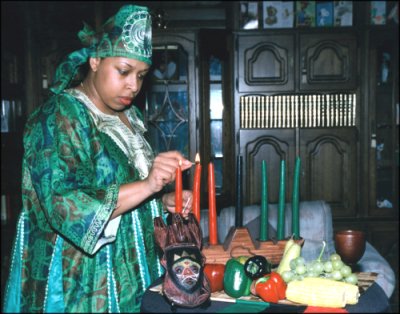
I wonder how many immigrants think all Americans celebrate Christmas regardless of their religious beliefs, cultural heritage, or family traditions. Hanukkah, Eid, and Kwanzaa fly just under the radar of mainstream American popular culture. Perhaps it is the immigrant’s remove from certain holidays, and their struggle to understand them, that is quintessentially the American experience. After all, it is the complexity of American diversity that makes this country what it is.

The Cultural Source of Chocolate, Mexican style

I grew up, like most people in this part of the world, eating European style chocolate. So having this Mexican traditional chocolate was revelatory.

Alex Whitmore, Co-founder of Taza Chocolate

If you attended last summer’s  Lowell Folk Festival and wandered into the foodways tent in Lucy Larcom Park, you would have seen (and tasted) that we were into beans. Cooks representing five different cultural cuisines shared their favorite bean dishes with the crowd (750 servings in all).

In an upcoming public program at Lowell National Historical Park, we will be exploring a different kind of bean. Just two days before Valentine’s day, we will present a program on the Mexican tradition of manufacturing, baking, and cooking with chocolate made from stoneground cacao beans.

As the date approaches, more info will be posted, but in the meantime, I thought I’d share some details from my recent visit to Taza Chocolate, a Mexican-style chocolate factory in Somerville, Massachusetts.

My guide was Alex Whitmore, co-founder of Taza Chocolate. Taza is one of several businesses located in an industrial building near the Cambridge/Somerville border.  Walking into the main entrance, I was immediately overwhelmed by the pleasant aroma of chocolate. If only one could record smells . . .

As companies go, Taza Chocolate is fairly new. Established in 2006, Taza is dedicated to manufacturing minimally processed chocolate made from fair trade organic cacao beans. Rotary stone mills from Oaxaca are used to grind the roasted beans.

Before touring through the factory, Alex and I sat down for an interview. Turns out, Taza is one of only 18 companies in the United States that are a “bean to bar” chocolate manufacturer, meaning rather than buying processed chocolate, they actually make chocolate from cacao beans bought directly from growers in Central America.

The majority of businesses making and selling chocolate are called “chocolatiers.” They may make delicious chocolate candy but they buy they don’t start by roasting and grinding their own cacao beans. The smooth, melt-in-your mouth chocolate we associate with Swiss, Belgium, and Italian confections is a relative newcomer on the scene. As Alex reminded me, the indigenous peoples of Central and South America consumed chocolate primarily as a drink for thousands of years before the delectable substance was introduced to Europeans. “The [cacao tree] is indigenous to Central and South America. And because of that, it became culturally important as a food stuff in the early civilizations of the Americas. The Europeans didn’t actually get their hands on the cacao bean until after the Columbian exchange when the Spanish brought it back over to Europe. They didn’t really start making chocolate as we know it today, in a solid form until the late 1700s, early 1800s. And It wasn’t really developed until the mid to later 1800s as a fine candy.”

The chocolate made at Taza differs significantly from chocolate manufactured around the United States. “We make chocolate in a very specific tradition . . .  The entire process is very much inspired by Southern Mexican chocolate making.”

Cacao beans come from the theobroma tree, which grows best in a hot and humid climate. The fruit of the theobroma tree is a cacoa pod, which contains seeds called beans. Alex points out that “Because Taza chocolate is made with such  minimal processing, our product tastes like our ingredients.” What this means is that it is really important for the company to personally source their beans, buying directly from farmers with which they have developed a personal relationship.

Once the beans are harvested, they are fermented and dried before being shipped to Taza. Fermentation creates more complex flavors. Alex made the comparison between the taste of flour and water, like matzoh (unleavened bread) to the more complex taste of bread made with yeast.

I asked Alex about his time in Oaxaca, Mexico, where he studied under several molineros (Spanish for stone ground millers.) In this part of Mexico, being a molinero is a family tradition which is passed down from father to son and kept rather secretive. Although Alex learned a good bit about dressing the grinding stones, he was never allowed to see stones with freshly cut patterns.

As is done in Mexico, Taza uses granite milling stones to grind their cacao beans. They hand chisel each millstone with a pattern specifically designed for grinding chocolate.

Stone ground chocolate, like stone ground grain, leaves granular bits behind, which gives Taza chocolate its rustic texture. After our interview, Alex led me through the factory to see various stages of production – winnowing, grinding, roasting, tempering, molding, and packaging. Taza also runs a retail store, and offers factory tours to the public three times a week.

If you’d like to meet Alex and learn more about their unique products and philosophy, plan on attending our program on February 12, 2011 at Lowell National Historical Park — Visitor Center. Details to follow.

Offerings to Placate the Dead

The days are getting shorter, the weather colder. Pumpkins are in abundance and grocery store shelves are brimming with packaged candy. Also to be expected are skeletons and ghosts, jack o lanterns, gravestones on people’s front lawns, ghoulish storefront windows, and, come Sunday, hoards of costumed kids roaming their neighborhoods in search of treats.

Halloween has been commercialized for so long that some youngsters may not know that this very American of holidays has cultural antecedents around the globe. For example, the ancient Celtic festival of the dead, Samhain, the Italian All Soul’s Day, the Japanese Festival of Lanterns, Obon, the Mexican Dias de los Muertos, and the Cambodian Ancestor’s Day, Pchum Ben. Common to all of these autumnal festivals is the belief that the souls of the departed return to the world of the living for a short period of time. All of them also involve offerings of food. Although Halloween takes place on the last day of October, and Obon in late August, the Cambodian Ancestors’ Day usually occurs in mid-September and lasts for a lunar cycle. The latter, a 15-day observance, is regarded by Cambodians as a time to commemorate and be reunited with deceased relatives. It is an especially important day for those with bad karma who have yet to be reincarnated and are trapped in the spirit world. 

Search the internet and this desciption by Vathany Say pops up from 2003 on the Khmer Institute website:  “Before sunrise on the morning of the Kann Ben [the 14 days leading up to Pchum Ben], special food is prepared for the ancestral spirits to enjoy. Favorite dishes of various flavors and colors are offered. They range from the simple and traditional nom ansom (sticky rice wrapped in banana leaves with assorted fillings) to the more elaborate and rich amok (steamed fish fillet marinated in a complex mix of spices and herbs).
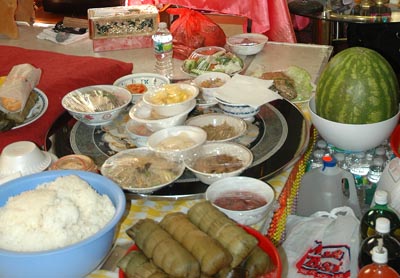
As a gesture of kindness, the hosts also prepare bai ben (steamed sticky rice mixed with sesame seeds and then formed into balls) to be thrown into shaded areas about the temple grounds. This mixture is an offering to the hungry souls who have been forgotten or no longer have living relatives to make them offerings.”

This description of Cambodian foodways associated with Pchum Ben was written about contemporary practice in Cambodia, but it could easily apply to ritual practice here in the United States. Indeed, we observed just this sort of alimentary offering in the shaded area of the parking lot of the  Triratanaram Temple in North Chelmsford, Massachusetts. Founded in the 1990s, Triratanaram temple is home to Buddhist monks in the Merrimack Valley and is an important place of worship for the Cambodian community of Greater Lowell.


We had come to view the stupa which had been built for the Triratanaram Temple by Yary Livan and Samnang Khoeun.

But we had no idea that our visit on September 24 would coincide with Pchum Ben. Before entering the Temple, Maya Men, an employee of the temple, gave us a brief tour of the grounds. At the edge of the parking lot we noticed six plastic bowls filled with food and incense. Maya explained that today was a special celebration – Phum Ben – the end of a two-week ritual celebration memorializing the dead. Samnang notes, “It’s a celebration of our ancestors.” Maya adds, “It’s like Halloween. In our culture, we believe that the dead – we don’t know whether we go up or down. There are three levels to Hell. At this time of year, they let out all of the dead for 15 days. People who have committed a lot of sins, they cannot see the sun.”

“Like vampires?” I ask. “Yes. During this time, they let them out from the underworld, before sunrise. You call for them. The food is an offering to the dead – a way of placating them so they won’t cause you harm.” Indeed, these poor souls, known as Priad spirits, are said to fear light and can only recieve prayers, food, and be reunited with their living relatives during the darkest day of the lunar cycle, which is the day of Pchum Ben.


Maya explained that the monks only eat before noon. A breakfast and a lunch. We headed toward the Meditation Hall and could hear the chanting, which was amplified. Samnang explained that he would bow three times – once for the Buddha, once for the darma (the Buddha’s teachings) and once for the monks, but assured us that we did not have to, “If you don’t believe.”

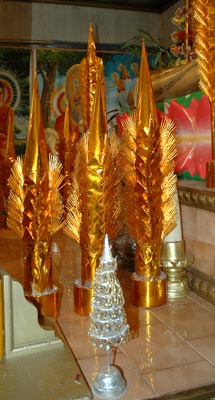
Removing our shoes, we enter.  Inside are monks and nuns and laity, sitting on the carpeted floor facing the abbot, Venerable Sao Khon Dhamathero. Many of the women wear white blouses adorned with delicately embroidered white scarves. The chanting and prayers were loud. It was difficult to hear Maya and Samnang explain what was going on and what things meant. The sweet, pungent smell of incense filled the air. At the altar were several statues of Buddha besides the main marble one from Burma. Behind this large Buddha was a round disk emitting colored flashes of light. Below, an assortment of food and liquid offerings included cooked rice, mushrooms and coriander, bananas, a bottle of ginger ale, and a Starbucks Frappuccino coffee drink. A metal bowl was filled with 49 rice balls – symbolic of the 49 days the Buddha fasted before becoming enlightened. Honey-colored, shiny paper spires reached toward the sky.

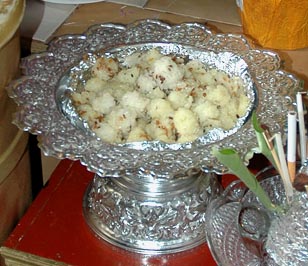
     

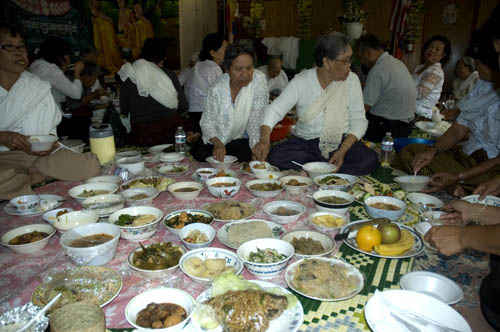
The chanting and prayers ended soon after noon. We were invited to join everyone for lunch. We accepted, a bit embarrassed to be imposing. Everyone sat on the floor to eat, circling many bowls of various dishes – noodles, caramelized pork, vegetables, fried banana, banana leaf wrapped around bean paste and sticky rice, and soups. 
When we left, we were offered a goody bag of sorts – two large gold-colored shopping bags filled with what appeared to be donated food and supplies: a box of Yogi cereal, a huge bag of low-fat potato chips, flavored instant coffee, toothbrushes, toothpaste, Motrin, Dove soap, and a loaf of packaged bread. All items had been blessed by the abbot. Leaving with the overflowing bags was an uncanny reminder of trick or treating, but with a Cambodian twist.

All photos by Maggie Holtzberg, 2010.

Resources, resources!


There was a time in the not-so-recent past when you had to know your way around a library, a card catalogue, and the periodical index if you wanted to do any kind of serious research in folklore studies. Oh how things have changed. Wikipedia is one thing, but it lacks the imprimateur of scholarly review. If you can’t get yourself to a university library, but still want to dig deep into folklore research, there is a handy alternative. 

We were delighted to learn about a new resource that makes folklore books, journals, and gray literature (things like white papers and policy materials, conference programs, presentations, syllabi, and teaching materials) available to all via the internet. It was developed by the American Folklore Society and the Indiana University Libraries and it is called Open Folklore. Go explore . . .

Cambodian elders tour Lowell National Historical Park

The Cambodian community has become an important part of Lowell’s ethnic urban history. During the 1980s, Lowell was one of a handful of official resettlement communities for Cambodian refugees fleeing war, genocide, and famine. Coming with little in the way of material wealth, many settled into a community known locally as “The Acre” — an area that has served as a gateway neighborhood for generations of immigrants coming to Lowell in search of a better life — Irish, Greeks, Poles, Scots, Portuguese, French Canadians, Italians, and Puerto Ricans. 

This section of Lowell got its name back in the 1840s when mill owners, who were concerned about having immigrant Irish workers living in their midst, donated an acre of land southwest of the city’s center. Today’s Acre is larger than its name implies and is home to many Camobodians. 

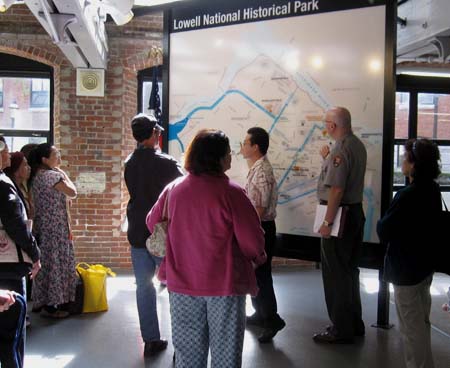
Last week, we hosted a group of Cambodian “elders” from the Coalition for a Better Acre  at Lowell National Historical Park. Chief of Cultural Resources David Blackburn pointed out the Acre and several Park and downtown destinations on an orientation map in the Visitor Center. 


Some members of the group had immigrated to Lowell in 1985, others more recently. Only two had visited Lowell National Historical Park, and no one had ridden the trolley. They were excited! 

Ranger Joanne Marcos shared Lowell’s history through stories of mill girls, labor conflicts, and new immigrants settling into ethnic enclaves — all of which were translated into Khmer by Rasy An, staff member at Coalition for a Better Acre, and Duey Kol, Assistant Director of Cultural Programming at the Park.

The group of visitors was especially animated when entering the Boott Cotton Mill Museum. Standing around a water-powered loom, one man recalled his mother weaving by hand in Cambodia. They marveled at how hard the mill girls worked, the heat and humidity, the long hours, the deafening roar and clack of machinery.

Our last stop was a visit to the Boarding House exhibit where they saw what the mill girls ate for breakfast, the tight sleeping quarters, and the clothing they wore. On the way out, we stopped briefly into the immigration exhibit — where the last panel of a timeline focused on some of Lowell’s more recent immigrants. There on the wall was a black and white photo from 1985 of a Cambodian family taken at the TWA terminal in Boston. One women in the group pointed to a man in the photo, who turned out to be her brother-in-law.  What a welcome surprise for them to see their story on the wall, for all to see.

This was the first of what we hope will be many interactions with the Cambodian community through our new partnership with the Coalition for a Better Acre. Through this visit with us, it was apparent that, despite the language barriers, they came away understanding Lowell’s importance in America’s industrialization and how they fit into the city’s story. In the future, the Park plans on nurturing relationships with other ethnic communities throughout the city.

Working Waterfront Festival: Come Celebrate America’s Oldest Industry

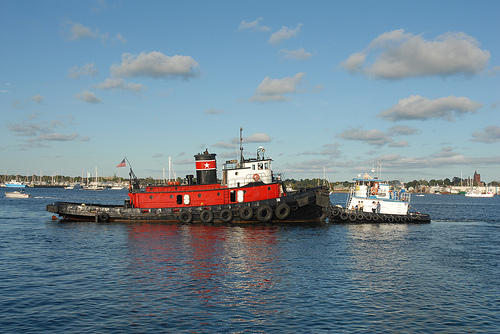
Great weather and great programming! We suggest heading down to New Bedford this weekend for the 7th annual Working Waterfront Festival. This year’s theme is All in One Boat: the Cultural Mosaic of New England’s Working Ports

In addition to the focus on cultural diversisty, the festival programming speaks to the common challenges facing fishing communities around the globe, especially in light of recent changes in fisheries management. Come enjoy live maritime and ethnic music, listen to tales from Cape Verdean Longshoremen, try your hand at mending a fishing net, watch a coast guard rescue demonstration, walk the decks of a scalloper, eat fresh seafood, and immerse yourself in an insider’s view of the local industry that brings seafood from the ocean to your plate.

We are happy to see that retired fisherman, Marco Randazzo, who we met years ago in Gloucester, will be demonstrating his knot tying and rope sculptures on Sunday.

Marco Randazzo with some his rope sculptures. Photo by Scott Alarik, 2000.

Local Learning through Folk Arts


In honor of National Arts in Education Week, we are singing the praises of a wonderful new web resource: Local Learning: The National Network for Folk Arts in Education.  Here you will find resources and best practices culled from the work of folklorists, folk artists, and educators around the country who have spent the past two decades working to integrate folk arts into classroom.  They make a compelling case for how educators can draw on traditional culture and local knowledge to enrich education and create stronger communities

css.php