Traditional Arts Fellowships Available


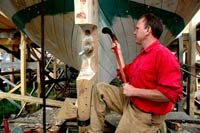
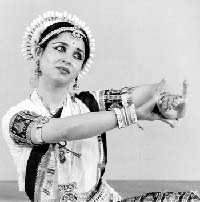
Cape Breton fiddler Joseph Cormier, rhythm tap dancer, James Godbolt, a.k.a. Jimmy Slyde, wooden boat builder Harold A. Burnham, Malian balaphon player Balla Kouyaté, and Irish step dancer Kieran Jordan  . . . these are just some of the individuals who have been awarded MCC Artist Fellowships in the Traditional Arts since 1999.  All were recognized for their artistic excellence within art forms that are deeply rooted in tradtional and ethnic culture.

These fellowships are awarded biennually.  The postmark deadline to apply is October 7, 2012. Guidelines are available online.


Scenes from a folk festival

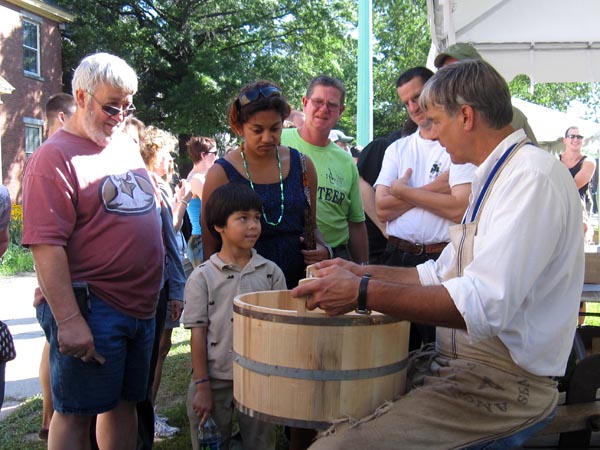
The Lowell Folk Festival is best known for its spectacular array of traditional music and ethnic food. Perhaps less well known is the Folk Craft & Foodways demonstrations that take place every year in the shade of Lucy Larcom Park. From watching fishing flys being tied and seeing how Abenaki baskets are woven, to handling newly constructed Puerto Rican musical instruments, it’s an area that encourages a special kind of hands-on interaction that kids especially enjoy.

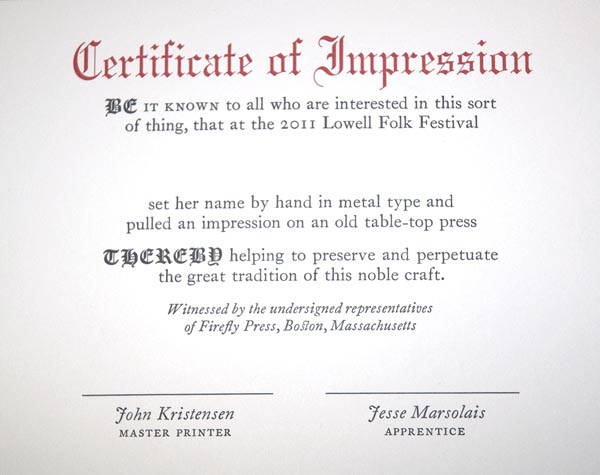
Folks that stopped by the letterpress printing tent got the chance to set metal type in a composing stick and then pull an impression (i.e., print) their own name on a table top  press.

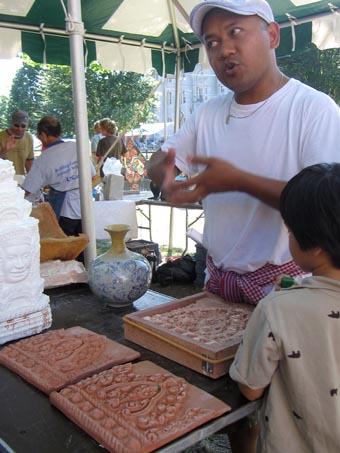
Samnang Khoeun explained the carving and casting ofan element of Cambodian ornamental design known as kbach.

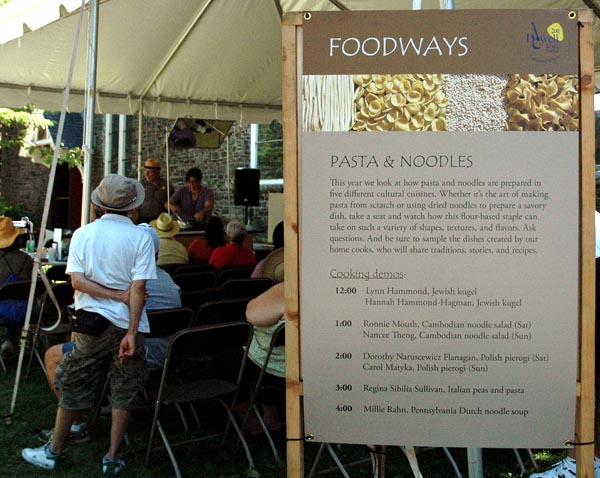
Just across from the craft demonstrations was the large Foodways tent. Here, people had a chance to watch cooking demonstrations and sample noodle and pasta dishes from five different cultural cuisines.

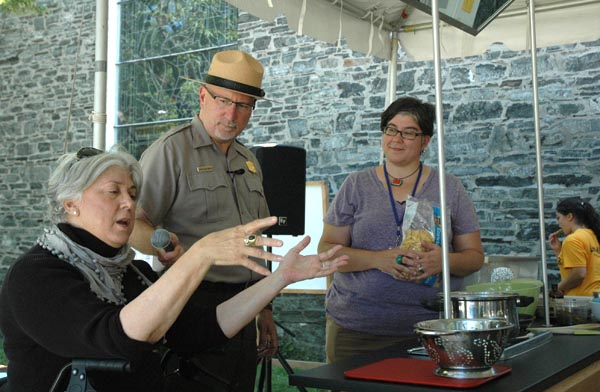
The demonstrations started at noon with Jewish noodle kugel. Hannah Hammond Hagman and her mother Lynn Hammond, shared a recipe which has been handed down in their family for four generations.

Ronnie Mouth shared her mother’s recipe for cold Cambodian noodle salad.

Other dishes that were presented over the weekend included Italian pasta and peas by Regina Sibilia Sullivan, Polish pierogi by Dottie Flanagan and Carol Matyka, and Pennsylvania Dutch chicken corn noodle soup by Millie Rahn. In addition to the welcome shade of the tent, the crowd seemed to enjoy hearing stories about  family traditions, cooking tips, recipes. . .

. . . and those delicious samples!

All photos by Maggie Holtzberg

The Pierogi Queen

We first met Dorothy “Dottie” Naruszewicz Flanagan at Holy Trinity Polish Church during the “Blessing of the food” Easter Saturday. Remember those sculpted butter lambs? So we weren’t surprised to learn that Dottie is also known locally as the “Pierogi Queen.” Raised in Lowell’s Polish community, Dottie, who learned to make this pasta delicacy from her mother, aunts, and grandmother, shares this fact, “Pierogi has always been a part of our life. It’s a staple, especially at Christmas time.”

Dottie invited us to her home to watch her make pierogi along with her good friend Carol Matyka. Carol also grew up in Lowell and the Dracut area, but now lives in Boston. Her family is all of Polish extraction. When we meet, Carol tells us, “I was looking forward to coming today because Dottie is the master of making pierogi. It’s been many, many years since I’ve made them and I wanted to re-establish my roots in Polish cooking.”

Dottie and Carol have prepared the fillings ahead of time. Dottie assures us there aren’t enough hours in the day to prepare the fillings and the dough all on the same day. One filling is made with two kinds of farmer’s cheese, potato, and onion and the other is made with cabbage and sauerkraut.

Carol has mixed and kneeded the dough, which, like noodle or pasta dough, contains no yeast. She rolls it out to an eighth of an inch, then uses the top of a glass to cut out circles of dough.

Next, Dottie fills the circles of dough with filling, wetting the edge to seal the deal. She reinforces the seam by pressing the edge of a fork into it.

Carol points out that if you look at pierogi about to be boiled, “They look like Italian ravioli, Chinese pot stickers, empanadas — every culture has its version of the same thing.”

The pierogi cook for about ten minutes, or until they float. Then, using a slotted spoon,  Dottie lifts them out and gently places them into a pan of melted butter, before letting them rest on a tin-foiled pan.  And of course, it’s time for a taste. The pierogi are delicious; in the boiling process, the farmer’s cheese has melted and the dough is buttery soft. You can’t get a taste and texture like that from store-bought pierogi.

Making pierogi for a crowd is labor intensive. In addition to making large batches of pierogi for the day before Christmas, known as Wiligia, pierogi is made for other special occasions, like wedding showers and baptism receptions. It is usually a group effort, not unlike quilting bees or barn raisings used to be.  Dottie says that at Christmas time, she and Carol’s sister make about 300 pierogi. “We can’t do that alone. We had six people here cooking one day and we were able to make twelve dozen in one night . . . Ideally, you have one doing the dough and rolling it out, one doing the mixing, one taking care of the pots, one putting them in the freezer.”

Carol goes to mix up another batch of dough, adding flour as she goes, “We’re going to start with two cups of flour, but you’ll see, as I’m working the dough, I’m going to have to add more.”

“That’s another thing you get to know,” Dottie adds.  “The feel of the dough. You get to know that it actually talks to you.”

“And what does it say to you?” I ask.

“Sometimes it says, ‘I’m not ready,’ and sometimes it says, ‘O.K,'” Dottie answers, to the sound of sizzling butter in the background.

Before we leave Dottie’s kitchen, I get a chance to try my hand at making pierogi.

For more cooks’ secrets and a chance to taste some of Dottie and Carol’s pierogi, be sure to come by the Foodways Tent at 2:00 pm on Saturday, July 30 or Sunday, July 31 of the Lowell Folk Festival.

Life lessons through doll making

On July 12, 2011, Puerto Rican dollmaker, Ivelisse Pabon de Landron, and her apprentice Jamielette Figueroa will do a demonstration at 2:00 p.m. in the Ashland Public Library. They will be sharing skills passed on during their 9-month Traditional Arts Apprenticeship, which was funded by the Massachusetts Cultural Council.

Among the skills young Jamielette learned are hand sewing, joining seams for clothing construction, drawing, cutting fabric, paper pattern making, use of a thimble, color wheel, tape measure, and sewing machine, preparing fabric, stuffing techniques, shearing for skirts, making hair out of yarn, and hand embroidery. These are things that used to be taught in home economics classes, if not not something that most girls learned firsthand from their mother or grandmother. Nowadays, how many youngsters are adept at sewing?

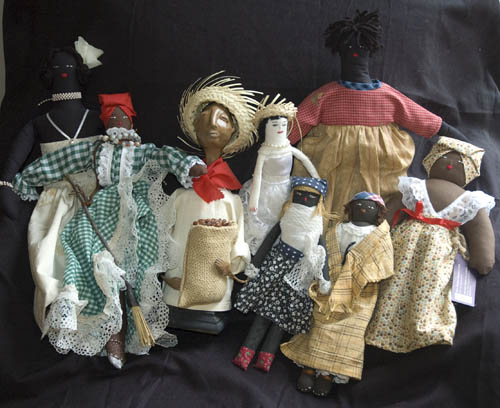
Perhaps, more importanty, these sewing lessons were steeped in folk cultural context. In addition to working on the technical craft of doll making, Ivelisse made sure that Jamielette learned about the history of Puerto Rico and the folk culture of its people. She came to understand that many of the skills that were passed on from one generation to the next were honed during times of hardship, when many rural people could not afford to buy the necessary things to survive, let alone provide toys for their children. Years ago, mothers taught their daughters the craft of making dolls using socks, old garments, corn husks, and banana leaves. To bring this history to life, Ivelisse and Jamielette created characters from Puerto Rican folkore such as the nana (care taker of children) camadronas (midwives), jibaros (farmers) and African bomba y plena dancers.

Ivelisse was a demanding teacher in the way great teachers are. On occasion, Jamielette did not meet her expectations, turning in a half-hearted job. Ivelisse took the opportunity to teach Jamielette the importance of taking pride in what you do. Through hard work and attention, Jamielette grew to meet Ivelisse’s expecations. It helped that master artist and apprentice share the same heritage, Spanish language, and spiritual faith.

The July 21 public demonstration will serve as a dress rehearsal of sorts for a Ivelisse and Jamielette. They will be joining eight other master artist/apprentice pairs participating in the summer’s Lowell Folk Festival. Come by and see them in the Folk Craft & Foodways area along Lucy Larcom Park on July 29-31, 2011.

Fiddle Heaven

An impressive group of fiddlers from around the country is gathering this week to teach at Boston’s Berklee College of Music for the Mark O’Connor Summer String Program. They represent a wide array of styles, including bluegrass, jazz, Irish, classical, Scottish, blues, hip hop, Texas swing, and more. Best of all, the stellar faculty are performing in a showcase concert Friday night at the Berklee Performance Center. Whether you are a fan of string music or an aspiring musician, this show promises to be full of virtuosity, authenticity, authenticity, and heart.

Under One Tent: Duck Decoys and Fishing Flys

The Folk Craft area at this summer’s Lowell Folk Festival focuses on the role apprenticeships have played in helping to sustain traditional art in New England. Below are two master artists and their apprentices that will be sharing a tent in Lucy Larcom Park. We are thankful to our friend and collegeague, Lynn Graton of New Hampshire Folklife  for connecting us with these talented craftsmen.

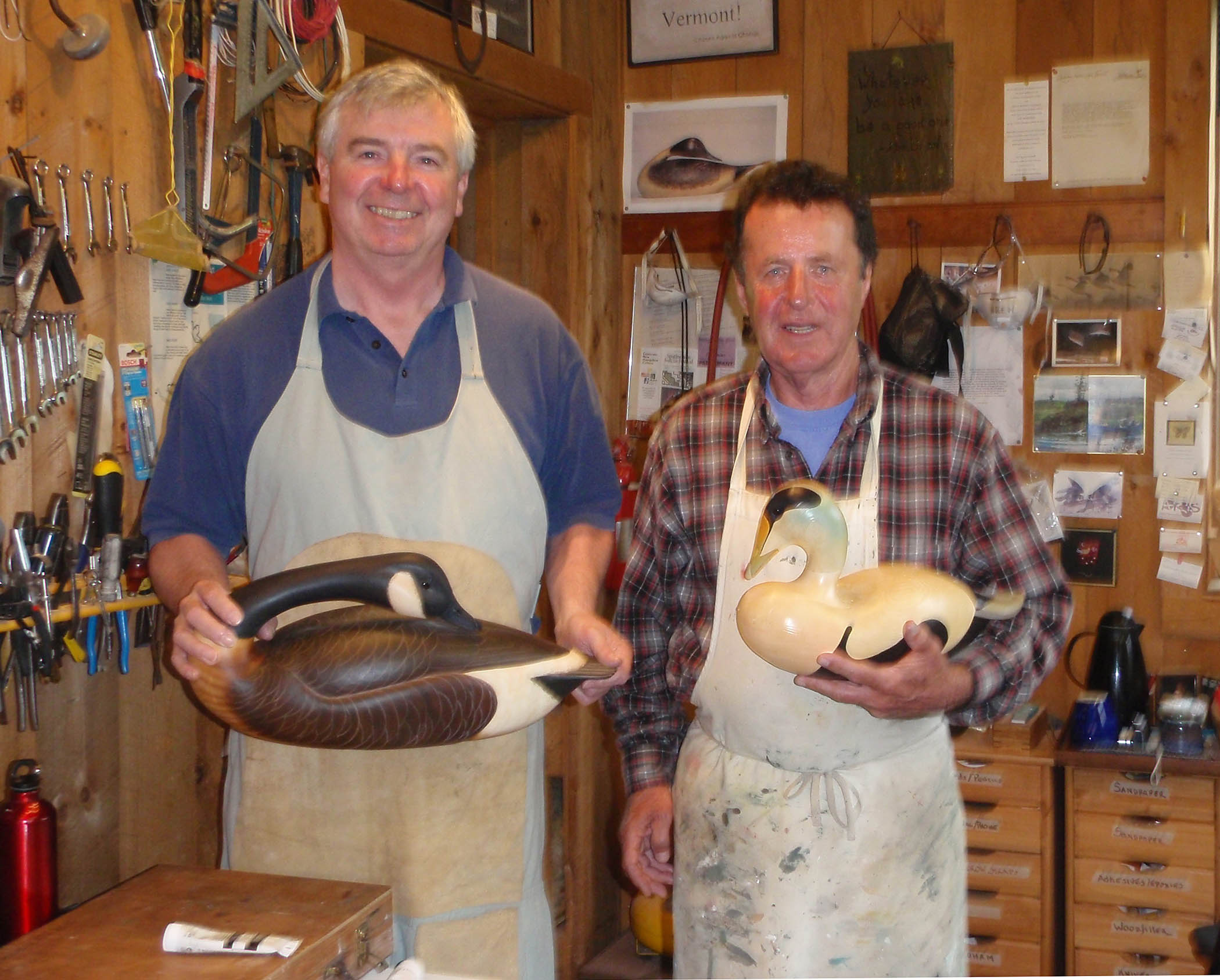
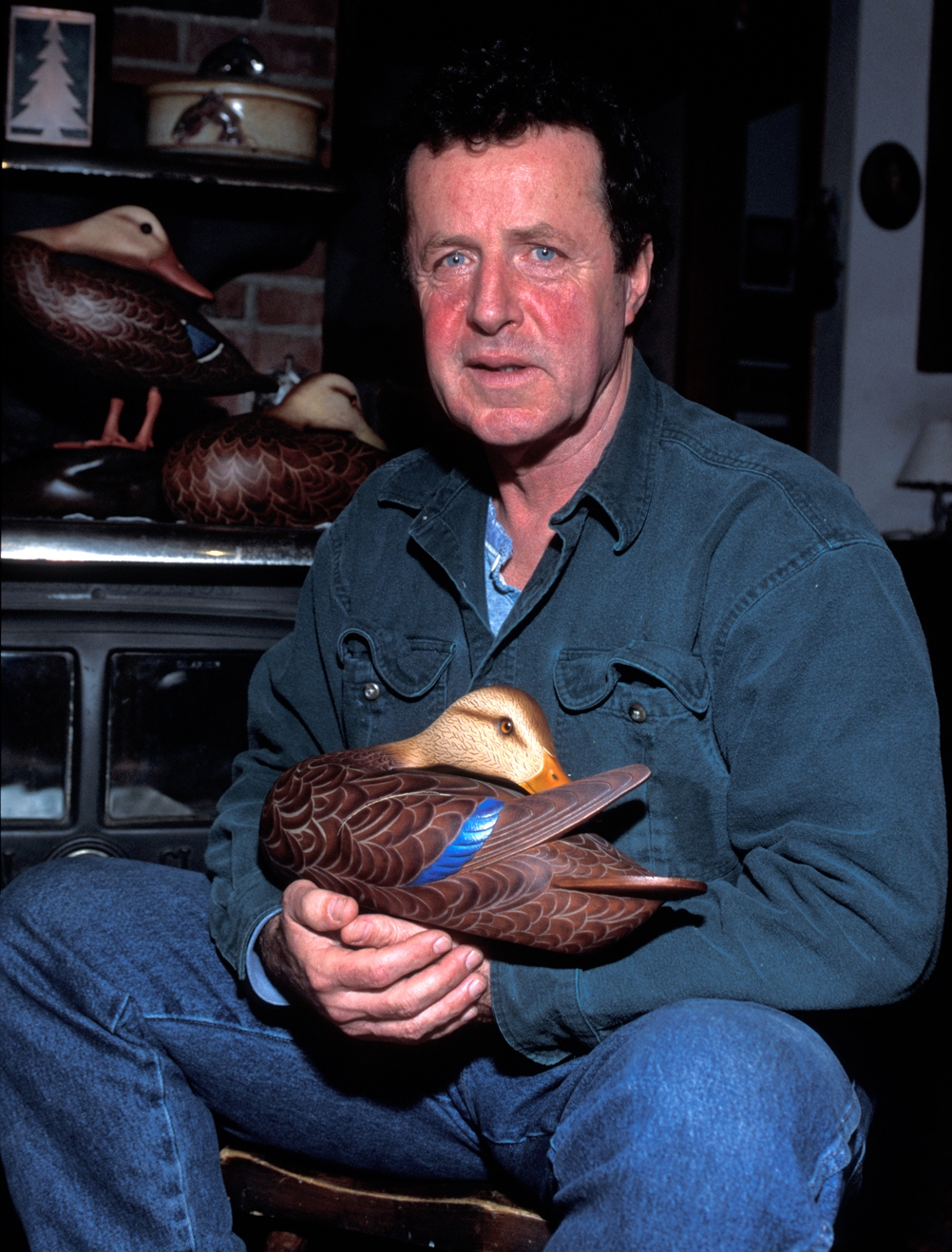
Making a beautiful decoy starts with being a keen observer of wildlife, in order to mimic the postures and grace of a variety of wildfowl and songbirds. Skills in carving must be matched by skills in painting. Layers of carefully applied paint help create the sheen and luster of feathers. Fred Dolan, of Strafford, New Hampshire,is a nationally recognized wood carver, specializing in waterfowl and songbirds. In addition to having studied under master carvers both in New England and in the Chesapeake region, Fred has studied ornithology and  worked with New Hampshire Fish and Game officials to band geese as a way of studying the birds at close range.

Fred works primarily with cedar, basswood or tupelo wood. He uses a variety of techniques such as combing to simulate wavy lines;  stippling to diffuse light and provide texture;  airbrush techniques to create iridescent highlights and shadows;  as well as hand painting of feather details. Gary Trotter is one of several apprentices Fred has mentored through a Traditional Arts Apprenticeship grant awarded by the New Hampshire State Council on the Arts.

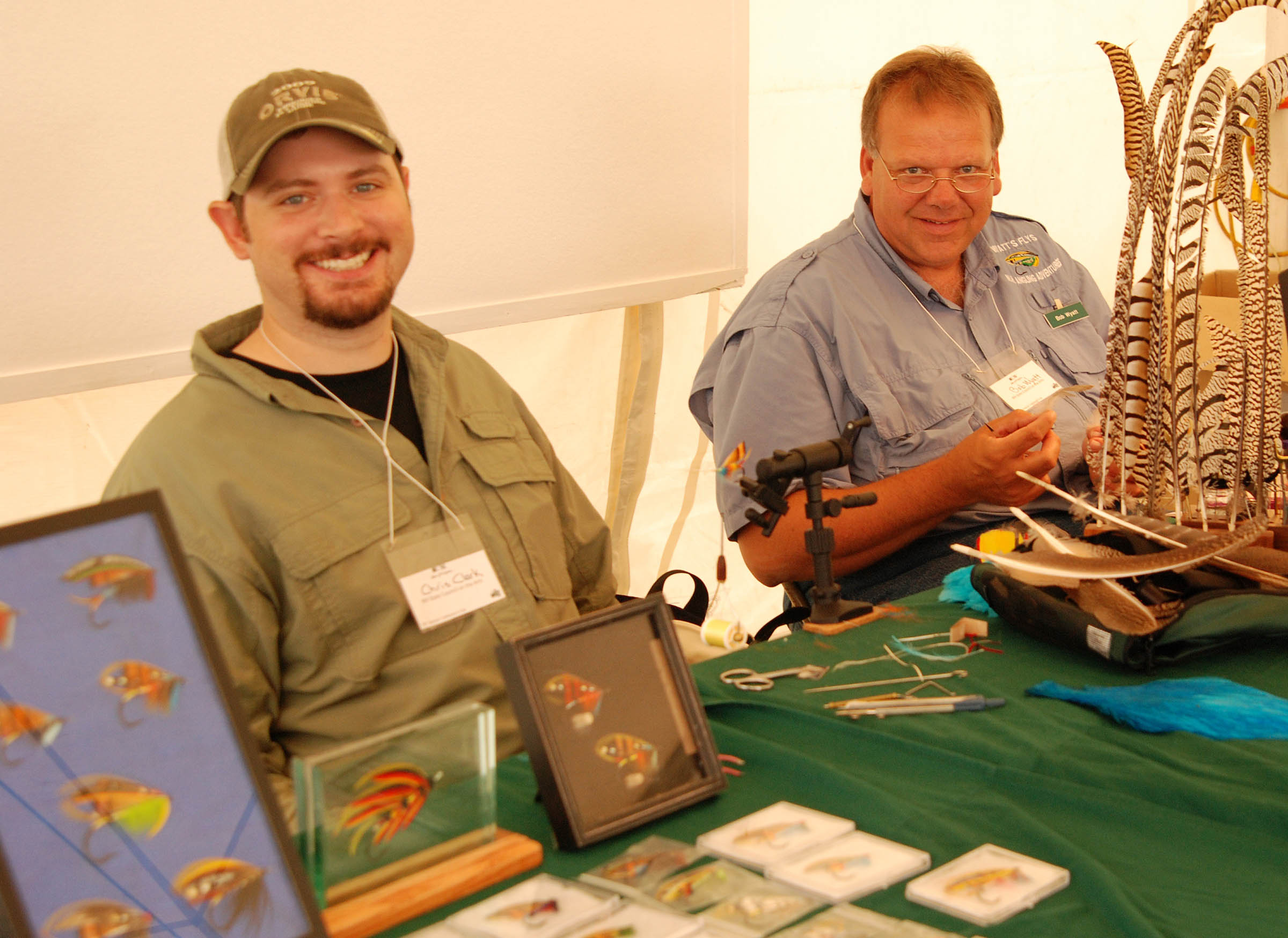
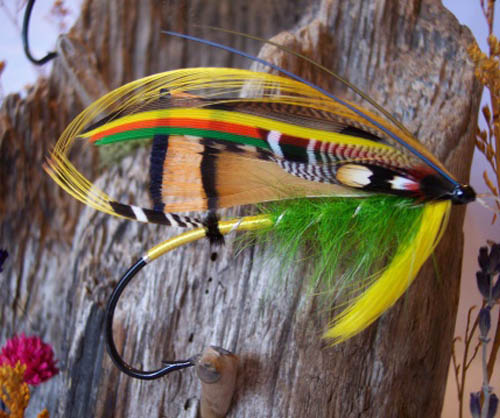
Fly fishing has been around for centuries, but the greatest advancements to the tradition were made in19th-century England. Flys are a combination of feathers, fur, and wire to imitate the look, color, wiggle, and silhouette of a bug or bait for fish. As Lynn Graton writes, “Classic Atlantic salmon flys are considered by many to be the king of the ornamental flys and are collected and displayed for their jewel-like beauty.” With up to 30 or 40 steps and taking several hours to complete, they represent the pinnacle of fly tying art. The distinction between working flys and classic Atlantic salmon flys, with their exotic feathers, is akin to that between working decoys and decorative decoys.


As a child, Bob Wyatt watched his father tie Atlantic salmon flys on family fishing vacations in Nova Scotia. The fly is used to catch “the king of fish,” says Bob, who now preserves fly tying as part of New Hampshire’s outdoor heritage. In 2009, Bob  was awarded a grant from the New Hampshire State Council on the Arts to mentor Chris Clark, who runs an outdoor adventure guide business.

Getting your fabulous folk content to an online audience

You know you have great content – it’s the folklorist’s stock in trade. But getting your folklore content to an online audience and engaging repeat visitors can be a challenge. Do you have questions about the technical, geeky side of things? Want ideas for how to design, structure, and then market your folk web site/exhibit/etc.?

If so, consider registering for the South Arts webinar on June 16, 2011 covering best practices for getting your folk content to an online audience. Folklorist Maggie Holtzberg and MCC Technology Project Manager Dawn Heinen will present. Topics will include: Leveraging a physical exhibition into an online presence, designing and implementing the user experience, and bringing it all to market.

This South Arts project is supported by an award from the National Endowment for the Arts.

Free Traditional Irish Dance & Music Performance on June 4


Traditional Irish dance and fiddle music will fill the Merrimack Repertory Theatre on June 4 in a program sponsored by Lowell National Historical Park.

Fiddle player Laurel Martin and step dancers Kieran Jordan and Kevin Doyle are all recipients of 2010 MCC Traditional Arts Apprenticeship grants. These publically-funded grants allowed these artists to provide a year of one-on-one teaching to talented apprentices Natayla Kay Trudeau, Emerald Rae, and Nicole Leblanc.

This free concert presents a unique opportunity for collaboration, as teachers and students come together to present the results of their apprenticeships and insight into their teaching methods.

Come join us for an exciting evening of solo, duet, and group performances revealing the history and shared languages which these artists express, preserve, and pass on.

Place: Merrimack Repertory Theatre, 50 E. Merrimack Street, downtown Lowell

Time: 8:00 p.m.

No tickets required. For more details:  click here

Event presented by Lowell National Historical Park and funded in part by the National Endowment for the Arts, the Massachusetts Cultural Council, and the Southern New England Traditional Arts Apprenticeship Program.

Of kielbasa and butter lambs

The priest used to come to every house to bless the food . . . They’d go from house to house, all by foot too.    Mary Dudek, Holy Trinity Polish Church 


Our good friend and colleague Pauline Golec is a native Lowellian who, for many years, has done much of the behind-the-scenes work that goes into producing the city’s festivals. If you’ve come to the Lowell Folk Festival and enjoyed the enticing array of ethnic food for sale by community groups, you have Pauline to thank.

Pauline is also a long-time member of Holy Trinity Parish, the designated mother parish for the Polish Community in the Merrimack Valley. So it made sense that we pay attention when she alerted us to a local Polish tradition at Holy Trinity. Having cleared things with the monsignor, Pauline invites us to the “blessing of the food,” which is done on Holy Saturday at 9:00 a.m. and 11:00 am.

We arrive shortly before nine and see a gathering of parishioners. Though we spot a few children, most are older individuals. Some have grown up in Lowell’s Polish neighborhood; others are more recent immigrants from Poland and Russia. All have brought baskets of Easter food to be blessed.

It doesn’t take long to see the similarity of food items filling each basket — eggs, ham, kielbasa, horse radish, pickles, mazurek, (traditional Polish Easter cake), babka, (a sweet yeast bread), and butter lambs (wee lambs made of molded butter.) When asked, individuals talk about how each of these foods represents the meaning of Easter. The butter lambs represent Jesus, the lamb of God; the eggs symbolize life and Christ’s resurrection; salt his purification; horse radish, his bitter sacrifice; ham and kielbasa the joy and abundance of life. 

I’d been hearing about butter lambs associated with Easter for years, but had never seen one. Suddenly, here they are. Pauline points to some made by Dottie Naruszewicz Flanagan, “You see Dottie’s? She’s got a flock.” Indeed, these are some of the most impressive butter lambs in the room. She has made 20 to give to neighbors and friends, which she presents on a paper plate with colored eggs. When I comment on the attention to detail, Dottie explains, “I mold and my daughter swirls. And as she’s swirling (using a toothpick to simulate the lamb’s wool,) my grandson and I are doing the eggs.”


After admiring Dottie’s array of food, we meet Frank Markarewicz who has brought his food to be blessed. Rather than nestled into an Easter basket, his food is unceremoniously concealed in a brown paper grocery bag.  We all laugh as Pauline teases, “From the sublime to the ridiculous! Straight from Market Basket.”

We are introduced to Jane Markiewicz Duffley, whose butter lambs are much larger than Dottie’s. To make her butter lambs, she uses candy molds inherited from her father, who once owned Blue Dot Candy on Bridge Street. She kept the molds he used in making chocolate bunnies. “I use them for Easter to make the lambs out of butter. It’s a nice tradition. We’ve been doing this since we were little kids. The priest used to come to the house to bless the food.” 


There was a time when the Polish Catholic priest would visit each house to bless the food in Lowell’s Polish neighborhood. Not unlike the family physician making house calls, this is a thing of the past. Instead, the people come to the priest.

“Peace,” says Monsignor Stanislaw Kempa. Someone claps hands loudly to get everyone’s attention. Monsignor Kempa delivers the  special prayers for blessing the food, first in English, and then in Polish. When he announces, “Happy Easter. Hallelujah,” and procedes to sprinkle holy water while walking in amongst the assembled whose baskets of food line long tables throughout the hall. 


There is more visiting, exchanging of news, and cups of coffee. And then it is time to go home, blessed food and baskets in hand.


It’s not everyday that a city celebrates its 175th anniversary

On April 11, 2011, the city held a birthday party for itself, marking the 175th anniversary of its founding.

Lowell has been attracting immigrants ever since the 1830s, when the rapid growth of textile mills provided much needed employment. Yesterday’s parade was a physical manifestation of the city’s diversity, which continues to evolve.

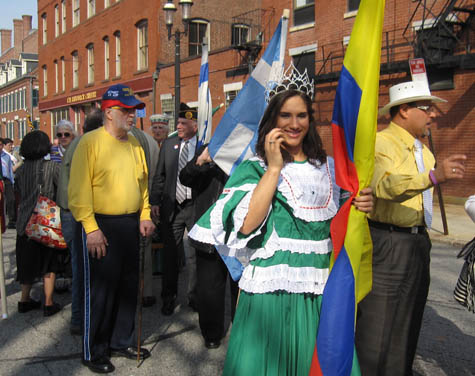
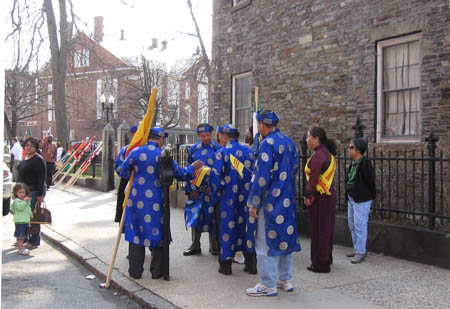
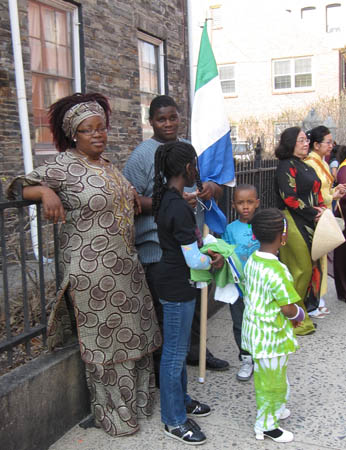
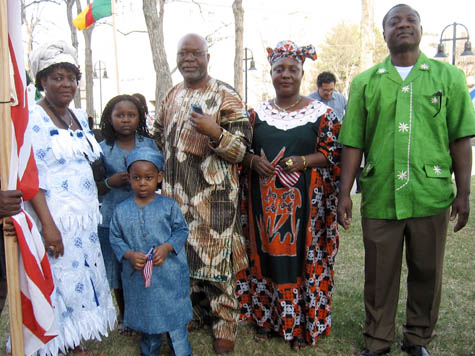
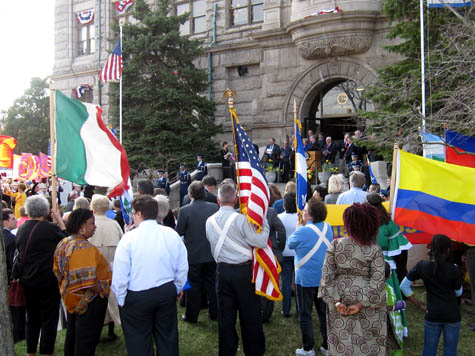
Just before 4:30, people gathered themselves in groups, in preparation for the  parade to city hall. Seeing those who turned out to march was a testament to the city’s changing demographics. Judging from the dress and the flags whipping in the wind, local participants had cultural roots in in Italy, Greece, Lithuania, Quebec, Portugal, Israel, Columbia, Vietnam,Cambodia, Sierra Leone, Liberia, Ghana, and Cameroon — and Lowell Pride.

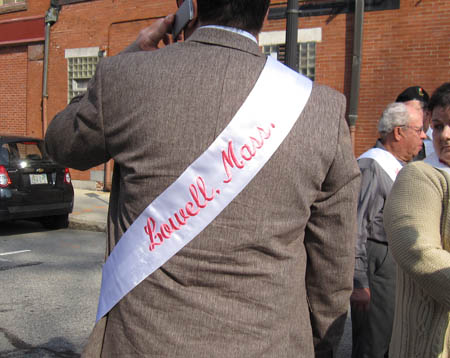
The celebration began with a  parade.

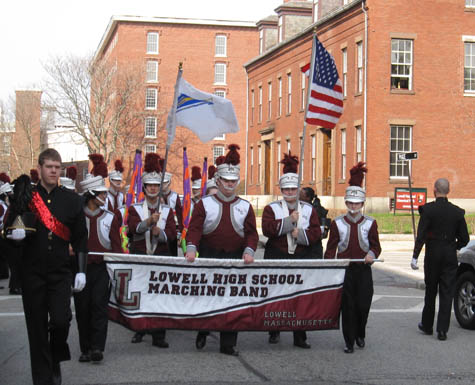
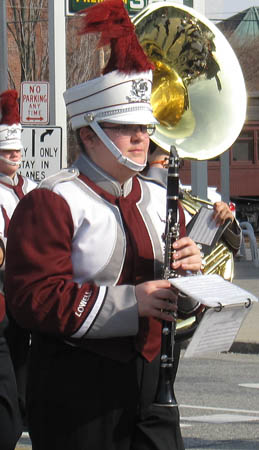
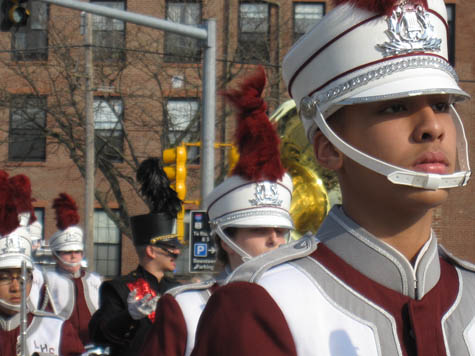
Lowell High School’s Marching Band did a fine job providing the rhythm.

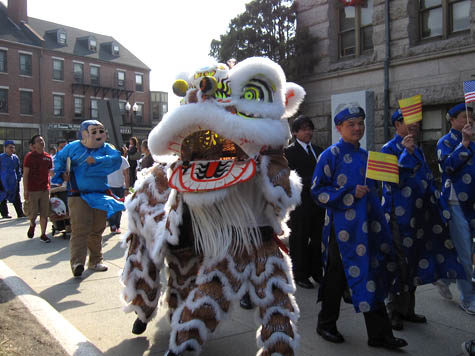
Approaching City Hall, a lion dancer teased the crowd.

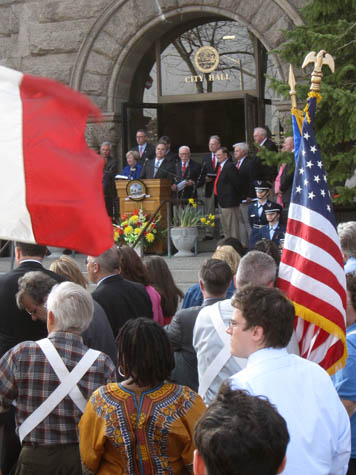
And then it was time for speeches and cake.

The celebration continues throughout the year with special events.

All photos by Maggie Holtzberg

css.php